
If it's not commercial, it's useless decoration
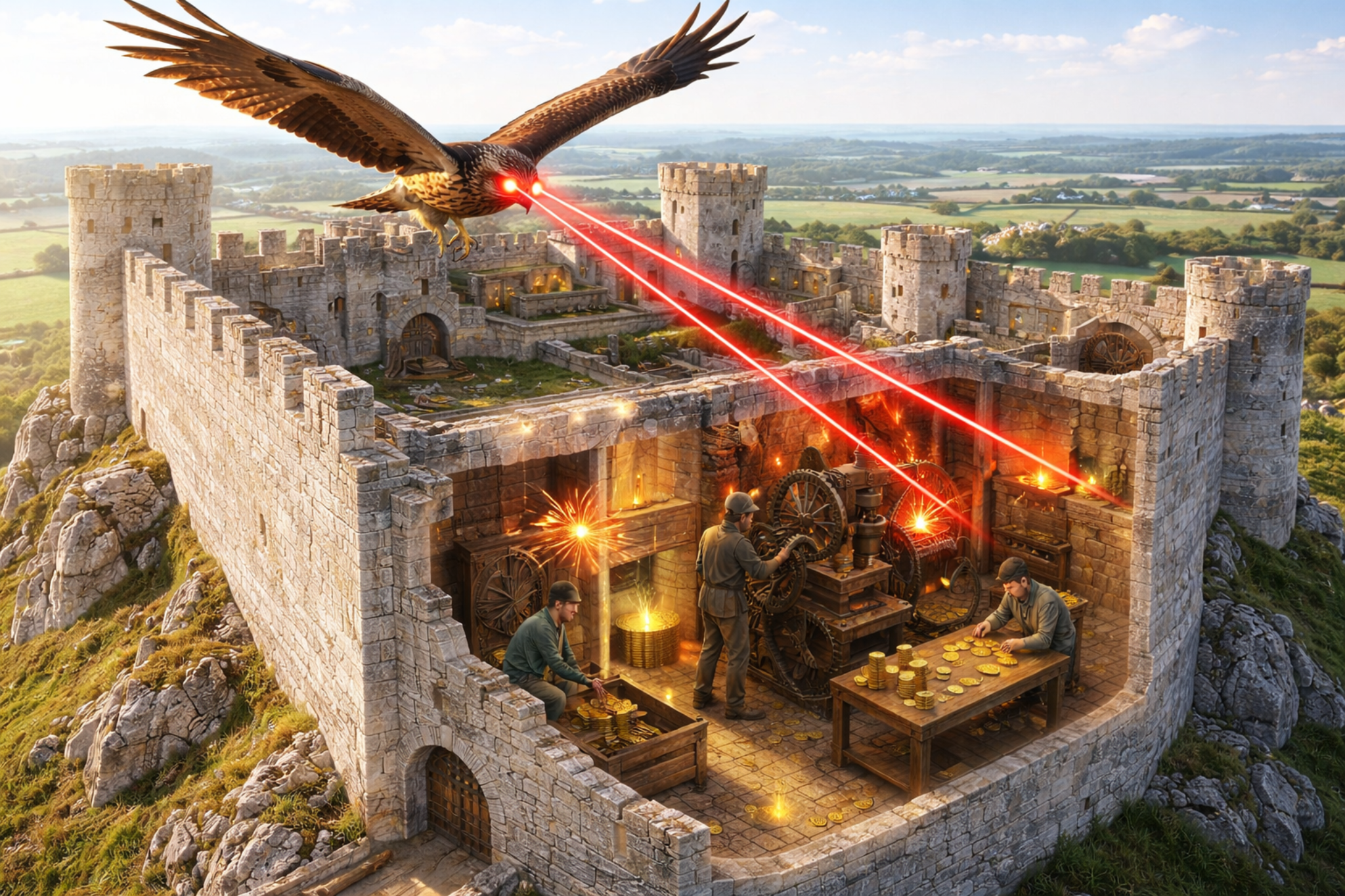
"A fortress without a commercial engine is just an expensive wall." © 2026. pitchhawk. Prompts by pitchhawk. Image by AI.
TL; DR
Every pitch has a story. Every deck has a vision. Every founder has an innovation they believe in deeply.
But belief is not a commercial engine. And investors don't back belief. They back the machinery underneath it — the revenue model, the unit economics, the scalability, the defensibility. The thing that turns innovation into a business that independent capital can recognise, scrutinise, and fund with confidence.
Most sell-side methods were never designed to discover whether that machinery exists.
pitchhawk is.
Investors don't back what you think they back
Investors don't back technology. They don't back ideas. They don't back decks, demos, or founders who can tell a great story in a room.
They back commercial engines.
Not the product. Not the revenue line on a slide. The machinery that turns innovation into a scalable, predictable, defensible business. A revenue model that makes sense at scale. Unit economics that hold under scrutiny. A go-to-market that doesn't require constant reinvention. Margins that improve as the business grows. A moat that actually protects something worth protecting.
That's what a professional investor is looking for the moment they sit across from you. Not the story. The engine underneath it.
And when it isn't there, or when it hasn't been properly built, tested, and stress-tested, no amount of storytelling, pitch coaching, or warm introductions will save you. And the wallpaper peels away the moment the real questions start.
The question almost nobody asks before it's too late
All founders have ideas. Most have an innovation. But whether that innovation can translate into a genuine commercial opportunity that scales, sustains, and attracts independent capital — that's the question almost nobody is asking before they walk into the capital markets.
Instead, they ask inward-facing questions. Is my deck sharp enough? Is my story compelling enough? Have I got the right introductions? Am I on the right platform? Have I cleared the readiness threshold?
None of those are the right question. They are all pitch questions. And the pitch is not the business.
The right question is the one an independent professional investor asks in the first ten minutes. It’s not about your vision, it’s about your engine.
How does it make money? At what cost? At what margin? At what scale? And what stops someone else from building the same engine tomorrow? What happens when you push down the pedal? How do margins behave?
Most founders cannot answer those questions with the precision and confidence that independent capital demands. Not because they’re not smart. Most are. Because nobody ever sat across from them, pulled the engine apart, and showed them exactly what was there and what wasn't.
Why the sell-side misses it entirely
Every piece of startup advice available to founders is built around the pitch. The deck. The IM. The data room. The approach strategy. The narrative. The vision. The messaging. The platform. The story of why this innovation matters and where it's going.
Brokers tidy up the narrative. Accelerators sharpen the pitch. Matching platforms score the deck dimensions. Pitch coaches work on the delivery. And all of it feels like preparation. Because it is preparation. Just not for the right thing. And it’s about as far away from readiness as the Earth is from Neuptune.
None of it forces founders to confront the commercial reality underneath the story. None of it asks whether the engine exists, whether it scales, whether it holds under the scrutiny of someone who has seen ten thousand deals and knows immediately when the numbers don't work.
Because the sell-side doesn't need the engine to exist. It needs the pitch to be good enough to get to the meeting. The meeting is where the sell side's job ends. What happens after that, whether the business holds up or crumbles, is the founder's problem, not the promoter, broker or platform's.
That structural reality is not a flaw in the sell-side model. It is the sell-side model.
What investors see when the engine is missing
A decorated idea. Wallpaper. Lipstick. Spin. Walls with nothing behind them. A fortress that looks imposing from a distance and hollow the moment someone walks through the gate and starts asking what's inside.
The moment a serious, professional investor starts pulling on revenue model assumptions, margin at scale, route to ideal customer, and path to profitability, the wallpaper peels away and the sparkle dulls.
What's left is either a business or it isn't. Either there's an engine or there isn't. Either the numbers hold or they don't.
And investors know within minutes. Not because they're harsh. Because they've seen it a thousand times. The polished deck. The compelling founder. The vision that makes sense. And then the commercial engine that isn't there or hasn't been built properly or has never been genuinely stress-tested by anyone with the experience and independence to tell the truth about it.
That's the moment the raise fails. Not at the end of due diligence. In the first serious conversation. And by then, the credibility has already been spent.
What building the engine actually requires
The commercial engine is not a slide. INor is it a financial model built in a weekend before a pitch. It’s the beating heart of the fortress. The thing everything else is built around.
Foundations that are solid. Walls that hold. Towers that surveil. Economics that scale. A battle-ready garrison rallying under one flag surrounded by a deeply protective moat. All of it built around a commercial engine that generates revenue that improves with scale, and that a professional investor can pull apart and put back together and still see something worth funding.
Without the engine, the foundations are ornamental. The walls are hollow. The moat protects nothing. You can build the most impressive-looking fortress in the ecosystem, and it will crumble the moment someone asks the question that matters:
“Nice walls, but where’s your commercial engine?”
— pitchhawk
Building it properly requires one thing that no pitch coach, accelerator, broker, or matching platform was ever designed to provide. An independent investor's lens applied directly to your commercial reality. Not your story, not your deck, not your delivery, but the actual machinery underneath the innovation. Stress-tested. Diagnosed. Rebuilt where it needs rebuilding. Strengthened where it needs strengthening.
Not a bot. Not a rubric. Not a cohort working through the same framework at the same pace toward the same demo day.
Real people. Real investment experience. Real scrutiny. Applied to your specific commercial engine, your specific business, your specific investment thesis.
The gap where great innovations go to die
The best innovations die in the gap between great idea and commercial reality. Not because the founders weren't smart. Not because the technology wasn't good. Not because the market wasn't there.
Because nobody forced them to build the engine before they walked into the capital markets. Because every solution available to them was sell-side and designed to gloss over the commercial engine with lipstick, not to discover whether one actually exists.
And lipstick doesn't survive the professional investor’s blow torch.
The business investability gap doesn't close by itself. And the fortress doesn't build itself.
But it starts with one conversation between two human beings. No cohort. No captivity. No equity. No conflicts. No agenda but yours.
Ready to find out if your commercial engine actually holds?
Mike 🖐

Innovation doesn't stall for lack of ideas.
It stalls in the gap between a great innovation and an investable business.
That gap never closed because nobody was incentivised to provide founders with an independent investor's lens.
pitchhawk is.
© pitchhawk, 2025-6. All rights reserved.