
Becoming fortress-strong investor-ready

“THAT’s a fortress” © 2026. pitchhawk. All rights reserved. Prompts pitchhawk. Image AI.
TL; DR
Check your innovation ecosystem and you will find multiple platforms and programs offering some kind of “readiness”. Some score it. Some package it. Others gatekeep it. And some even use it to funnel deals to investors, even when they’re not “ready,” by referencing it.
Most of it is built on relative scores generated by third-party AI, measured against other startups on the same platform, and dressed up as a standard that professional investors actually use.
It isn't.
There is investment ready. That’s documents. There is investor ready. And then there is fortress-strong investor-ready — the pitchhawk ® standard. Absolute, not relative. The gold standard of business and investor readiness. And no other system can reproduce it.
pitchhawk created it. pitchhawk is it.
Three levels. One gold standard.
Not all readiness is equal. And the difference between the levels is not a matter of degree, it's a matter of kind.
Investment ready is the first level. You have the artefacts. A deck. A data room. A one-liner. You look the part. You can walk into a room and appear prepared even when you don’t have an investable business to start with. Most founders reach this level and mistake it for the destination.
Investor ready is the second level. Some platforms and programs offer this, usually free, and usually as a funnel into someone else’s agenda. You're assessed and sometimes ranked. It feels like preparation. It is a better starting point than the first level. But it’s still not enough because it is a free funnel into a monetisation machine — and the moment a serious professional investor starts pulling on the real threads underneath your pitch, the difference becomes painfully clear.
Fortress-strong investor-ready is the pitchhawk standard. It’s the highest level and the gold standard of business and investment readiness. Absolute, not relative. The pitchhawk readiness level (PRL) ®, is subjective, not objective and not algorithmic and it’s only the starting point of the proprietary pitchhawk system. It’s built not from a rubric or relative/comparable scoring model, but from the inside of real transactions. Decades of investment and equity underwriting experience, billions in corporate deals across six continents, and an independent investor's lens applied directly to your underlying business and investment case.
pitchhawk created this standard, and it’s the original system built to close the business investability gap. While others have since taken inspiration from some of our language, none have replicated the substance. And no other system can reproduce the gold standard because it can’t be built from the outside of real transactions, nor can it exist as a free funnel into a deal flow program or platform that’s actually built for investors — not for you.
What the second level actually measures
When a matching platform tells you your investor readiness scores 73 out of 100, the question worth asking is: 73, but relative to what?
The answer, more often than not, is relative to the other startups it has crowdsourced and scraped.
Not relative to what a sovereign fund, family office, or institutional investor demands in an investment or an acquisition target. Not relative to the standard that capital markets apply when independent investment funds that they are stewarding are on the table.
The AI behind those scores is not proprietary deep analysis built from decades of real investment experience. It was not involved in those deals. It did not have a ringside seat. And there is no magical repository of information on which it can be trained because that “lived experience” was lived, not written in a book.
No. What’s assessing those scores is a scoring rubric wrapped around someone else's foundational model or productivity platform. They are superficial and written by non-finance people, with a few personal exits. People that have never made a vocation out of sitting on the buy-side of financial transactions where the stakes are all too real. That’s why the score compares one against the other instead of delivering a third party independent and subjective analysis and assessment.
Let’s just say that a score built on someone else's AI, applied to someone else's rubric, measured against someone else's scraped deal flow, tells you almost nothing about whether your business and investment thesis would survive one serious conversation with the independent capital that actually matters.
Don’t believe us? Go and try them, most are free. Just be careful who’s seeing your secrets.
Why the sell-side can’t reach the gold standard
The reason no platform, accelerator, or matching algorithm can deliver fortress-strength is structural. They are built on the sell-side.
Their readiness standard is readiness-for-the-maybe match. Readiness-for-the-pitch-night. Readiness-for-the-demo-day. Readiness-for-the-subscribers wanting high-frequency deal flow. And that bar is set by what the investors paying for the platform are willing to see and not by what the capital markets demand when a serious investor or buyer is conducting real due diligence on a real business with real money.
They are not incentivised to raise the bar. Their business model depends on deal flow, not on the quality of what's behind each deal. Your readiness is their product. And if it’s free you can bet someone else is paying them for it. Monetising you. The problem for you is that your outcome becomes your problem which is why your problem is never solved.
That's not a criticism of the people building these platforms. It's a structural reality of the platforms they are building, because it seems to them to be a good use case for AI. But the sell-side was never designed to deliver an independent investor's lens, because doing so would require them to be unconflicted, and unconflicted is precisely what they are not.
What fortress-strong actually looks like
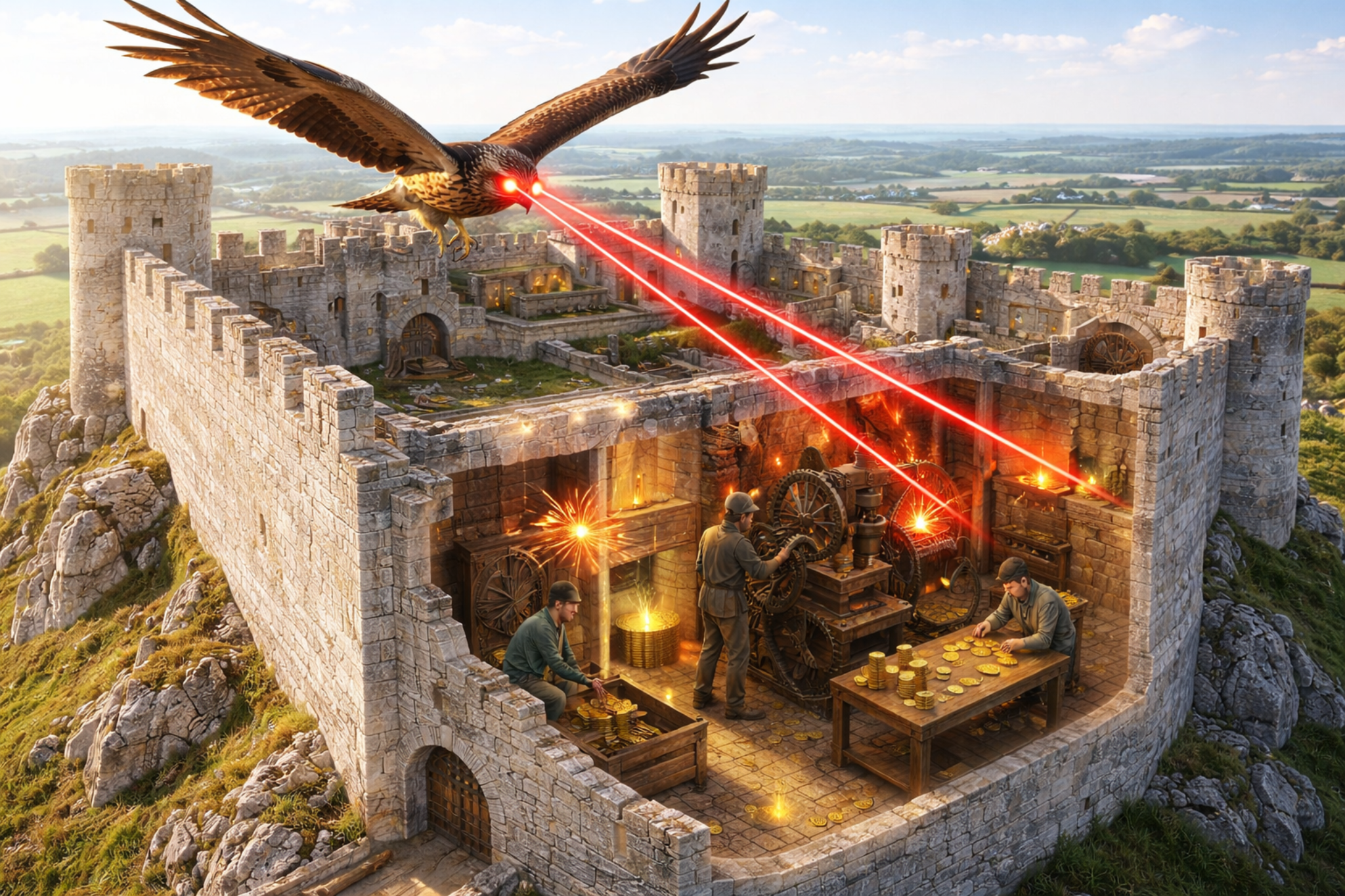
“Nice walls, but where’s your commercial engine?” © 2026. pitchhawk. All rights reserved.
Fortress-strong investor-ready is not a number on a dashboard. It is a state your business reaches when every element that professional investors actually look for holds — not against a rubric, but against the scrutiny of someone who has sat on the buy side of real transactions with real stakes and is meeting you for the first time.
What it really means is building your business as though you were building a fortress. Positioned to win trade. Foundations that are solid. Walls that hold. Towers that surveil. Economics that scale. And a battle-ready garrison rallying under one flag, surrounded by a protective moat.
Build those around your commercial engine and you reach fortress-strength — the point where independent professional investors can immediately recognise you as investable, scrutinise you without hesitation, and fund you with confidence. Or if you’re very early-stage, they can at least see credible evidence to prove you’re on the right flightpath to fortress-strength.
That is the gold standard. That is what pitchhawk delivers when we show you our battle-ready blueprints. And that’s what no AI wrapper, productivity platform, accelerator curriculum, matching platform, or captive club was ever built to produce.
The cost of stopping at level two
False readiness is the most expensive readiness of all.
Not because of what you spend getting there. Because of what you spend in credibility, relationships, and reputation when it crumbles in the wrong room. And it will.
A digital platform score will not protect you when a sovereign fund partner starts pulling on your investment thesis. A demo day stage will not protect you when a family office asks why your revenue assumptions don't hold beyond year two. A warm introduction will not protect you when the investor on the other side of the table realises in the first ten minutes that the business beneath the pitch hasn't been properly built, or it’s yet to be built out of the wrong materials due to third party agendas.
Investors have long memories and the capital markets are smaller than they look. Walking in under-prepared doesn't just cost you that raise, it costs you that relationship, that network, that reputation. Permanently.
And the business investability gap doesn't announce itself. It reveals itself at the worst possible moment, usually when you're already in front of the capital you needed.
The original standard
pitchhawk created the fortress-strong investor-ready standard. Not as a concept. As a working system, built from the inside of real transactions, delivered by real people with real investment experience, through a genuinely independent investor's lens. No AI. No third-party tech. No external funding. No conflicted channels.
Others have since taken inspiration from our language. But language without the substance behind it is as useless as an AI wrapper or noise in a crowded market — and business leaders and CEOs who have been around long enough know the difference between a platform selling access, and a system delivering the gold standard.
There is investment ready. That’s level 1. There is investor ready. That’s level 2.
And then there is fortress-strong investor-ready. The pitchhawk standard. The highest level and the only one that holds when the questions get hard, when the capital is serious, and when the room is the one that actually matters.
The business investability gap doesn't close by itself. And the fortress doesn't build itself.
But it starts with one conversation between two human beings. No AI. No cookie cutting. No cohort. No captivity. No equity. No conflicts. No agenda but yours.
Ready to find out where you really stand?
Mike 🖐

Innovation doesn't stall for lack of ideas. It stalls in the gap between a great innovation and an investable business.
That gap never closed because nobody was incentivised to provide founders with an independent investor's lens.
pitchhawk is.
© pitchhawk, 2025-6. All rights reserved. You may not copy, reproduce, repackage or imitate our content, frameworks or IP.