
From idea to investable business: the real lesson of SpaceX is on page 93
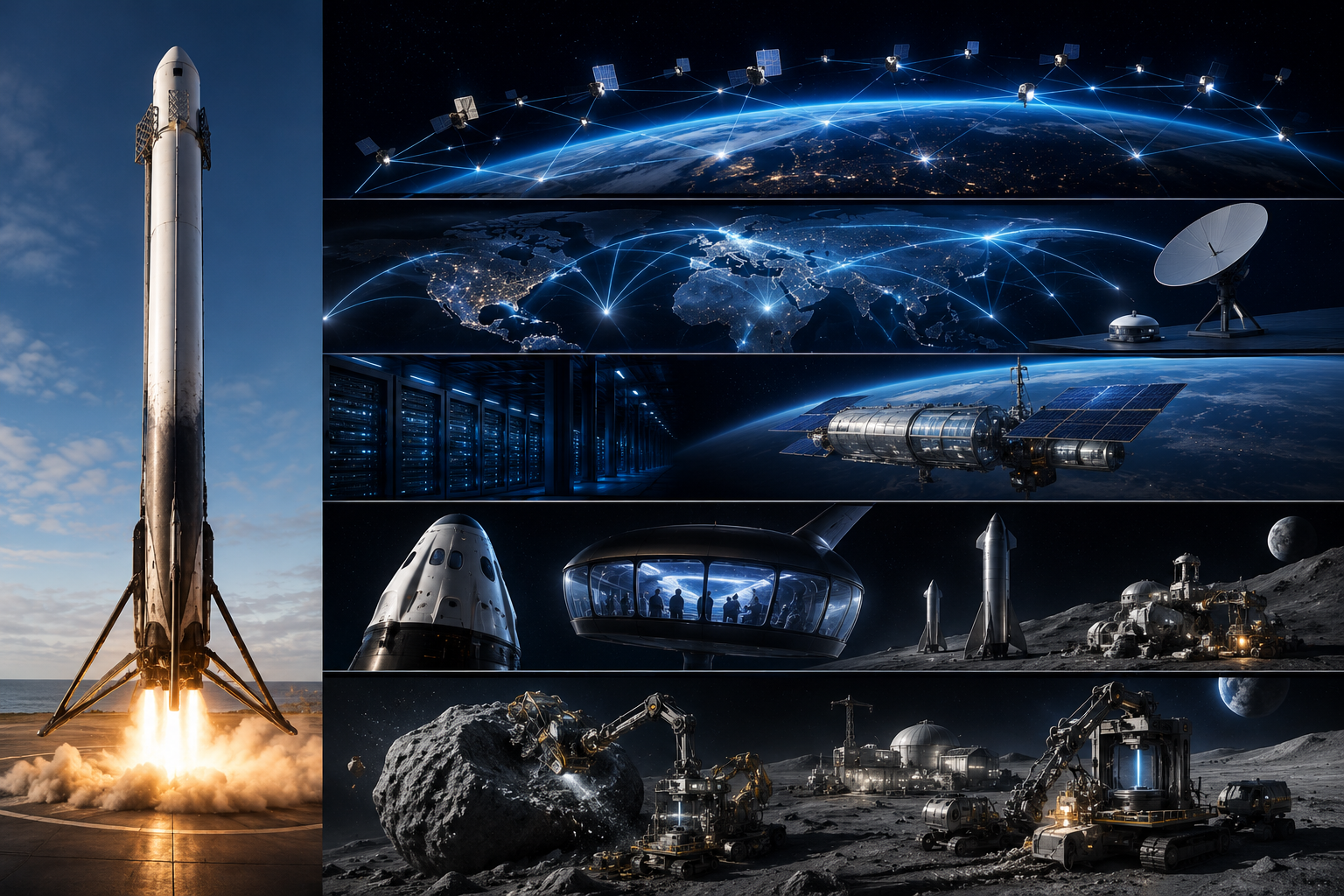
"What part of your rocket makes your rocket, rock it?" © 2026. pitchhawk. Prompts by pitchhawk. Image by AI.
The rocket fuel that actually fires
SpaceX President Gwynne Shotwell recently told the FAA the company is targeting 10,000 rocket launches per year within five years. Let me do the math on that. Um, that's 27 launches every single day.
That's the launch cadence required for the revenue forecasts to hold, for the commercial stack to scale, and for the valuation to ultimately make sense. If you're stress-testing the economic engine behind the story, 10,000 launches per year is the number you arrive at.
The reason is that at its core, SpaceX has built its entire commercial model around a single metric. Cost per kilogram to orbit. The S-1, i.e., the prospectus, repeatedly identifies launch cost and cadence as the foundational drivers of performance across the business. Reusability enables higher launch cadence. Higher launch cadence spreads fixed costs across more missions and reduces the cost per kilogram delivered to orbit. As that cost falls, activities that were previously uneconomic become commercially viable. That's not just an engineering insight. It's the flywheel.
Why? Because lower cost per kilogram makes it viable to launch more satellites. More satellites create more network capacity. More network capacity attracts more subscribers. More subscribers generate more cash flow. More cash flow funds more launch infrastructure, which lowers the cost per kilogram further. Every turn of the wheel expands the range of businesses that can be built on top of the platform.
And the biggest story is on page 93, which is to say that the company’s ambition is, through Starship, to reduce the cost to reach orbit by 99% or more relative to the historical average launch cost per kilogram according to NASA of $18,500, which would mean approximately US$185/kg.
That is an extraordinary number, and if (once) achieved, would fundamentally change the economics of space. Not just the GDP of a sector, but the opening chapter of an entirely new Gross Civilisational Output that makes every terrestrial economic milestone look like a rounding error.
But it’s the same leap every serious founder has to make. From idea to invention, from invention to innovation, from innovation to business, from business to something a professional investor will actually fund. Not the rocket engine. The commercial engine.
So, put aside the unprecedented trillionaire status for a moment and focus on the US$185/kg commercial engine and flywheel that engine was designed to power, and strap in.
Forget the valuation, focus on the framework that’s hiding in plain sight
Many founders think the journey looks like this: idea → raise money.
It doesn't. The journey that produces investable businesses actually looks like this:
Idea → Invention → Innovation → Business →Investable Business
Each jump is a different lens and skill. Each one requires a different kind of thinking.
The idea was blunt and audacious. Make humanity multiplanetary by dramatically reducing the cost of getting to space.
The invention was reusable rockets. The engineering breakthrough of landing an orbital-class booster back on a drone ship. SpaceX had invented something the world had never seen. Most founders stop here and call themselves innovative.
The innovation was something different entirely, and this is what is easy to miss, because reusability alone is not a business, it’s an engineering achievement. The commercial innovation was recognising that reusability is an elasticity model. If you can reuse a rocket, you can dramatically compress the cost per launch. If you can compress the cost per launch, you can launch at cadence. If you can launch at cadence, you can build a business in space that was previously impossible to build because access was too expensive, too scarce, and too unreliable to underwrite.
The invention was the booster landing on the ship. The innovation was understanding what that made possible commercially. And in this context and manifestation, reusability creates cost leadership and differentiation, all at the same time.
The closest analogy in business history is cloud computing. Virtualisation was the invention, which is to say VMware, hypervisors (the software coordinating the virtual machines) and the ability to run multiple operating systems on a single server. Impressive. But selling virtualised compute as elastic bandwidth where users pay for use and can scale instantly with no capital expenditure, that was the commercial (engine) innovation. That's what turned a data centre technology into a $500 billion industry. Nobody talks about the hypervisor. Everyone talks about the credit card and the API.
Amazon didn't invent the server. They invented the commercial model that made the server a utility.
SpaceX didn't invent the rocket. They invented the commercial model that makes the rocket a utility.
The business, where each layer earns and spawns the next
Once you have an elasticity model, the business layers follow. This is where the innovation story becomes the commercial story.
At its core, SpaceX has built a self-reinforcing flywheel around a single metric. The cost per kilogram to orbit. The prospectus repeatedly identifies launch cost and cadence as the foundational drivers of performance across the entire business.
Reusable rockets reduce the cost per kilogram to orbit. Lower costs enable higher launch frequency. Higher launch frequency supports larger satellite constellations. Larger constellations improve network performance and customer acquisition. Growing cash flows fund the next generation of launch infrastructure, driving costs lower again and expanding the range of commercially viable activities.
Reusability → Higher launch cadence→ Lower cost/kg→ New commercial markets
The model shares some similarities with Amazon Web Services. Just as Amazon used falling cloud infrastructure costs and scale to create entirely new markets and applications, SpaceX is using declining launch costs to create new economic layers above the transportation stack. The difference is that SpaceX is highly vertically integrated, controlling much of the value chain itself and capturing the economics generated at each successive layer.
Reusable rockets make it viable to place tens of thousands of satellites into Low Earth Orbit. LEO communications infrastructure creates the foundation for Starlink, a global broadband network with millions of paying subscribers. Starlink's connectivity layer, combined with SpaceX's launch capability, creates the foundation for orbital data centres. Orbital data centres potentially unlock space-based AI compute at a scale that terrestrial infrastructure may increasingly struggle to match due to power, cooling and permitting constraints. Importantly, the company is no longer solely dependent on launch economics. As an infrastructure platform, it is beginning to participate in the economics of connectivity, compute and data as evidenced by the Anthropic and Google deals.
From there, the stack continues to build. Lower-cost access to orbit supports space tourism and eventually transportation services beyond Earth. Sustained human presence in space opens the possibility of lunar and asteroid resource extraction. Those resources could in turn support off-world manufacturing and industrial activity at scales that would be economically transformative.
Each layer exists because the one beneath it became commercially viable. The launch business enables the satellite network. The satellite network enables orbital compute. Orbital compute enables entirely new industries. Remove any foundational layer and the layers above it become far more difficult, or impossible, to sustain.
That caveat is important. The model ultimately depends on sustained mastery of engineering, manufacturing and capital allocation at a scale never previously attempted. It also carries an unusually high degree of key-person risk. Much of the market's confidence rests on the continued leadership of Elon Musk and Gwynne Shotwell, and whether the organisation can institutionalise their capabilities as it scales remains one of the most important unanswered questions. But the market has voted a resounding “hell yes” on both of those scores.
Yes, there is $29 billion in debt, and yes, many of the divisions are loss making, but that is current state and it’s the future state that’s supporting the financial metrics. And you can find the most important paragraph on that future state, that makes sense of the present-day state, on page 93 of the S-1.
Page 93
This is the real story. The commercial engine, flywheel and investment thesis packed into one metric — US$185/kg —it’s what’s backfilling the valuation and the future.
Here is a direct quote from page 93 of the S-1.
“Developing Starship. Starship is our next-generation vehicle that we expect will dramatically expand our launch capability through full and rapid reusability combined with unprecedented mass to orbit capability. As the most powerful launch system ever developed, we expect that Starship V3 will be able to carry a payload of 100 metric tons, and that future generations could reach 200 metric tons, potentially as soon as Starship V4. Starship is central to our goal of unlocking growth through our unique vertically integrated business model. Starship is expected to be the only vehicle with fully reusable first and second stages, which is critical to reducing launch costs and increasing launch cadence. We believe that Starship can eventually reduce the cost to reach orbit by 99% or more relative to the historical average launch cost per kilogram according to NASA of $18,500, establishing a scalable path to creating the infrastructure of the future, such as orbital AI compute.”
Note the comment: “Starship is central to our goal of unlocking growth through our unique vertically integrated business model,” and here is the math that lands hard:
Historical average launch cost per kilogram according to NASA of $18,500/kg albeit, traditional expendable rockets historically ranged from roughly US$10,000-20,000/kg.
Falcon 9 is widely estimated to be around US$2,500-3,500/kg depending on mission profile and assumptions.
Falcon Heavy can be lower on certain missions.
Starship's long-term target implied by the prospectus is around US$185/kg or less.
Read the last bullet point again 👆 and again 👆👆
The investable business is completely “on crack”
So, we have an idea, an invention, an innovation, and a business. But what about the corporate structure wrapped around it?
Well, yes, they did that. And it's at the structural, governance, succession and ownership level where Musk did something that has no real precedent in the history of large public offerings.
SpaceX went to market as the biggest IPO in history, $75 billion raised. The IPO was an all-primary raise, meaning every dollar went onto SpaceX's balance sheet to fund infrastructure and potentially to retire some or all of the $29 billion in debt, not into the pockets of existing shareholders (and according to Shotwell at the pre-launch function, SpaceX employees contributed $1 billion towards the raise).
Yet, to pull that off at record scale without surrendering control, Musk used a dual class share structure where Class B shares carry 10 votes each. The result is that he locked in 85.1% of total voting power while floating only a small slice of total equity to the public. He can only be removed as CEO, Chairman, and CTO by a vote of Class B shareholders, which he effectively controls himself. This was a “take it or leave it” proposition to Wall Street, and Main Street given the availability of stock to retail.
You can agree or disagree with the valuation and the structure. No one really cares what you or I think as individuals, because that’s what markets are for. The market voted on Friday. Next, it will weigh the company and dictate the real number over time.
But the structure itself is a statement. SpaceX succeeded where NASA and world governments failed, and that plus the importance and size of the AI and space economies (which are orders of magnitude above the market that Musk-dress-rehearsal-Tesla, sells into) appears to have earned the founder the right to lead it on his terms. That, and the fact that the recent equities bull market has left the world awash with risk-on investor liquidity.
Unorthodox? Completely. Precedent-setting? Possibly. Investable? So far, the market has voted yes! SpaceX is now a moonshot business positioned at the vanguard of an addressable market that’s out of this world, with a corporate structure built to protect the mission and the leadership that can execute things that NASA and the world’s sovereigns, could not.
The market has spoken. This is an investable business. How much of the $185/kg is already baked into the valuation will be weighed by the market in due course.
What’s your $185/kg?
So, what is the question that SpaceX forces every founder to confront?
What is the commercial innovation (and engine) that makes your invention viable at the scale your business actually requires?
Not what's technically possible. What's commercially viable at the cadence your model depends on.
Or, in two words and one number:
What’s your $185/kg?
At its core, SpaceX has built a flywheel around cost per kilogram to orbit. The S1, identifies launch cost and cadence as the foundational drivers of performance across the entire business. Every reduction in launch cost expands the range of economically viable activities in space, creating new revenue streams that can be reinvested into driving costs lower still.
Without the commercial innovation of the elasticity model, the invention stays an engineering achievement, and while that might be remarkable and celebrated, it’s not fundable at scale.
Most founders have an invention. Far fewer have the innovation that turns it into a business with all the right signals that are tuned to the frequency investors are listening to. That’s why they’re not fundable at scale and that’s also why scale is a key aspect of the commercial engine that you must know intimately, and well before you attempt to convince professional investors to back you.
Yet, that gap between invention and investable business is where most businesses and fundraisings fail. It's where most founder credibility quietly gets spent. And it's the gap that no one in the market has been incentivised or equipped to close. Until now.
pitchhawk helps founders design fortress-strength businesses and investment cases through an independent investor's lens. If your business doesn’t have its very own $185/kg, or if the foundations below it and the walls around it aren’t scalable, we'll tell you honestly. And then we'll help you fix it, personally, with no surface-level shortcuts, without conflicts, and while reducing your cost to get there by at least 90%.
Mike 🦅

Innovation doesn't stall for lack of ideas.
It stalls in the gap between a great innovation and an investable business.
That gap never closed because nobody was incentivised to provide founders with an independent investor's lens.
pitchhawk is.
© pitchhawk, 2025-6. All rights reserved.