
Investor readiness FAQ: What exactly does investor-ready look like?

Build an investor-ready fortress not a deck. © pitchhawk, 2026. All rights reserved.
The capital raising mismatch
Many founders describe their innovation as investment-ready. Far fewer actually have an innovation business that is investor-ready.
The difference is subtle in language, but material in outcome.
At a high level, investment-ready reflects the founder’s view, or what we call the Sell-Side. The deck is built. The model is done. The data room is stuffed. The “raise” is planned. The founder and their advisor/digital platform flick an arbitrary switch, signalling they’re ready to “raise”.
Investor-ready reflects the investor’s view. It answers a very different question though the lens of someone that wants to write out a cheque: is this a real business I am prepared to back with real money, today?
Quite the mismatch, no?
Investor-Ready vs. Investment-Ready
Being investment-ready often manifests after a furious level of preparation, mentoring, momentum, messaging, gloss, and wallpapering over pesky business gaps. This is the sell-side.
Whereas being investor-ready is about being business-ready, with an investable commercial engine that’s built on evidence and traction, not assumptions and hope. It’s the other side of the lens, the buy-side.
Most fundraising attempts stall not because the company lacks tech, effort or ambition, but because sell-side preparation, momentum and messaging has been mistaken for buy-side investability.
Put differently: Founders are ready to ask. Investors are not ready to say yes.
That mismatch explains why:
Strong meetings often don’t go anywhere.
Feedback stays positive but non-committal.
Your capital raising attempts drag on longer than expected.
The company and its advisors may be well prepared with documents, but the commercial engine and investment thesis do not yet withstand investor scrutiny.
Why is investor-readiness poorly served?
If investor-readiness is so important, why is it so rare?
The answer is structural. The capital raising or “money shop” industry was built on sell-side solutions, typically led by advisors and brokers seeking percentage-based fees from the issuer, and preparing sell-side documents as a cost-recovery exercise in the meantime. As its name betrays, the sell-side was never optimised for the founder or the investor. It was and still is optimised for the advisor/banker, digital platform, and sell-side support ecosystem.
That’s why most sell-side advisors, tools, and programs are built to help companies present and “speed date” for capital — not to judge whether capital should be deployed.
They optimise for investment-ready speed dating and do not look at the business through an independent buy-side lens. This is the result:
Heavy use of gloss, reach, narrative, messaging, momentum and FOMO.
Document-first mindset, more wallpaper, less underlying business.
Cost recovery for advisor, bill shock for founders.
Documents mistaken for progress and disregarded by investors.
Low to no ROI given spend can amount to hundreds of thousands of dollars, with no tangible results.
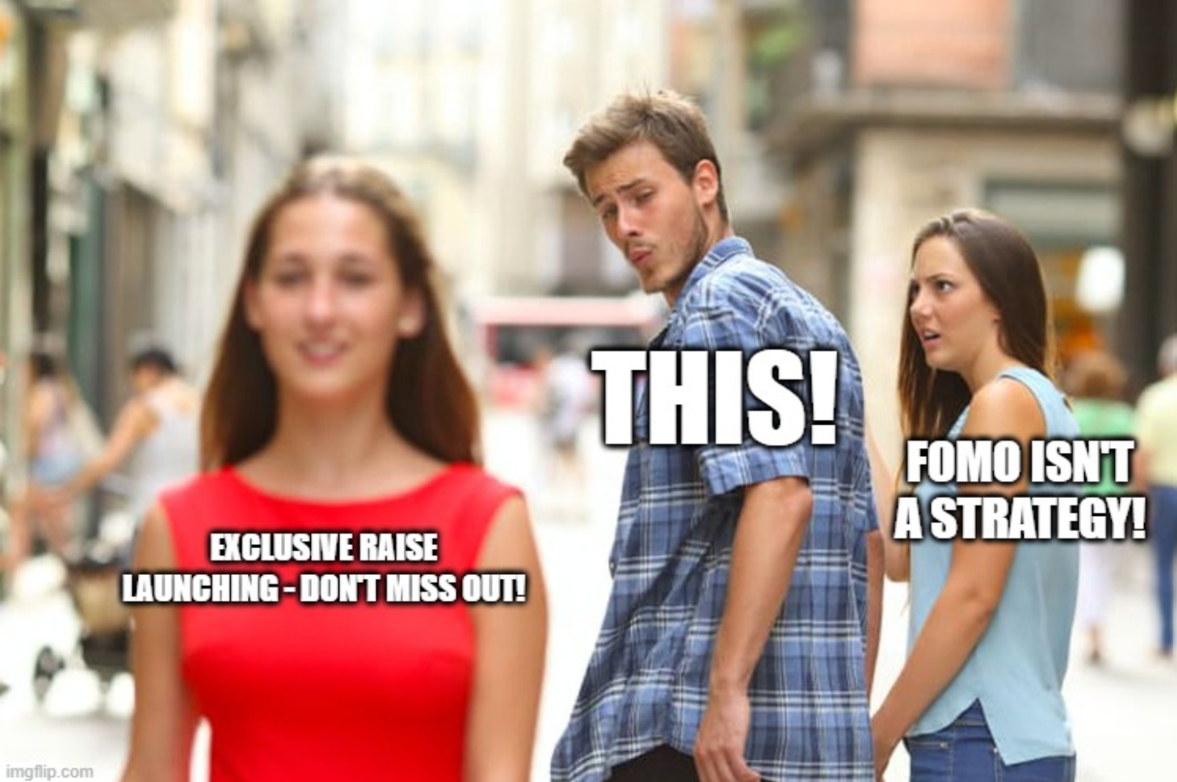
Sell-Side distracts.
Factoid: Sell-side distracts from the lack of a genuine commercial engine.
Most of all, none of this effort amounts to a true test of investability, nor any incentive to build a functioning commercial engine and investable thesis before going out to targeted professional investors.
Sell-side fundraising is often a high-velocity sales campaign dressed up as capital strategy.
Move fast. Maximise reach. Don’t get bogged down in awkward questions, especially valuation. Post-GFC, outfits like Y Combinator industrialised the model. Widen the funnel, trust the law of averages, and sidestep pricing altogether. Hence the invention of the Simple Agreement for Future Equity, or SAFE for short — low friction, not quite equity, not quite debt, but conveniently not a valuation either.
And that’s how we got here.
The missing perspective is the Buy-Side
True investor-readiness only exists when the business is assessed the way an investor would assess it. That means asking hard, practical questions:
Is this a real business, or a promising innovation?
Is the commercial engine clear, present, valuable, scalable, predictable and defensible and is the structure investable?
Are the risks clear, prioritised, and defensible?
Can this opportunity survive scrutiny beyond a pitch room?
Does the investment thesis make sense?
Would this stand up inside an investment committee?
This perspective is largely absent because the sell-side is not incentivised to adopt it:
The sell-side benefits from speed to percentage-based fees with cost recovery in the meantime, not investor happiness. It’s equity and you may lose all of your money! as the small font disclaimers say.
The buy-side focuses on fit, IP, customer, unit economics, traction, scalability, predictability, command & control, judgement, downside protection, capital discipline and other fundamentals.
As we highlighted at the start of this note, the gap between these two views is where most raises fail.
Where pitchhawk comes in
pitchhawk exists specifically to operate in that gap.
Map your structure. We show you how to see your business as the dominant fortress solving the biggest problem in your domain.
Diagnose and fortify. Through our unique Pre-flights we stress-test the business behind your pitch to determine whether a real fortress exists.
Signal readiness. We provide you with a readiness ranking that shows you how fortified/prepared your business is, and how you can improve your business and investment thesis to rank higher.
Build what’s missing. Where there are gaps in your fortress, we help redesign and strengthen the underlying foundations, walls, engines, and moat, etc — not the pitch deck!
Open the hidden doors. Achieve the highest level of readiness? You may be invited to opt into curated introductions who get what you’re building, via our exclusive partner network, adding an extra string to your capital bow.
That’s how we help you transform your innovation into an investable business—smarter, stronger and faster than sell-side methods and advisors that often crumble under the slightest pressure.

Fortress-strength investable. © pitchhawk, 2026. All rights reserved.
Fortress-Strength investor-ready?
Wondering if you’ve transformed your idea or innovation into a fortress-strength investable business? Here are some basic questions to ask.
Does it stand up as a commercial engine, not just a narrative?
Does it make money while solving problems and/or creating joy for customers in a way the competitors will struggle to compete against?
Is there a strong team working to a well thought out go-to-market strategy?
Is it scalable and predictable without heroic assumptions and luck?
Does it demonstrate risks that are understood and contained?
Does it have a moat that guarantees time, and that’s resilient to agentic AI?
Can the investment thesis be explained and objectively defended with evidence?
Is there an appropriate sharing of risk-adjusted returns and appropriate safeguards in place for investors?
Once these foundations, walls, moats, weapons platforms and other fortified elements can be evidenced, the “pitch” becomes credible because the business is credible.
And that’s when professional investors will be able to recognise the fortress that you’re building as an investable business.
If you can’t answer Yes to these questions, you need to contact us.
Takeaway
If investment-ready means “we are ready to raise,” then investor-ready means “an investor is ready to invest.”
Most companies never cross that line because sell-side processes, tools and advisors obscure where that line really sits.
pitchhawk was built to draw that line clearly, and to help founders build businesses strong enough to step over it — smarter, stronger and faster than sell-side methods that usually crumble under the slightest pressure.
Don’t let investors school you, reach out today.
Mike Ganon, Hawk1

pitchhawk exists to bridge the gap between innovation and investability. We transform innovations into fortress-strength, investable businesses by helping innovation leaders build the commercial foundations and investment cases most programs, processes, and sell-side advisors never address.