
Investor signals #6: Green energy and climate tech, the transition that refuses to be simple
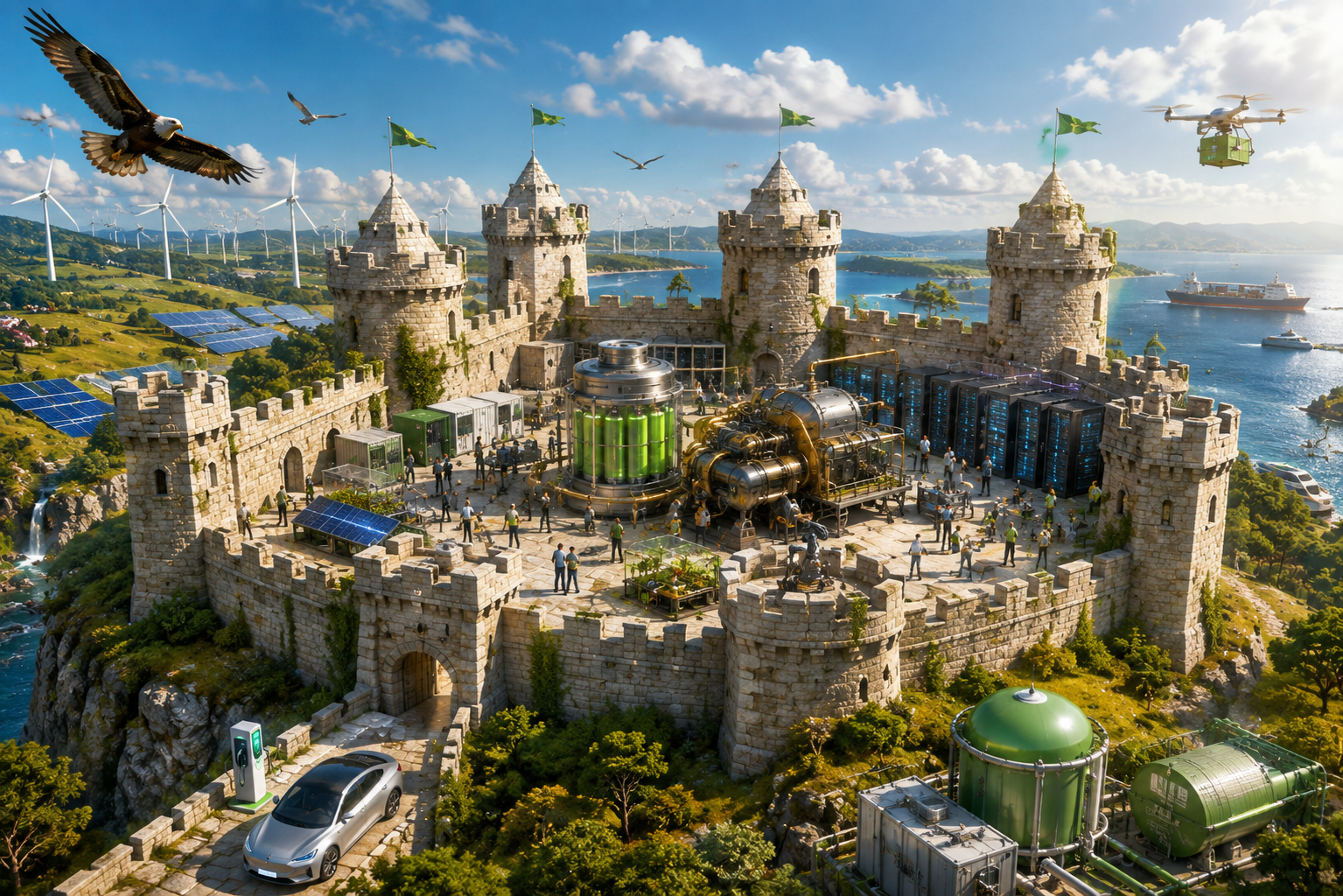
“Fortress-Strong Green Energy” ©2026. pitchhawk. All rights reserved.
The signal
The energy transition is one of the biggest investment shifts of our lifetime. That much is not in dispute. What is in dispute, and what has become increasingly clear through a bruising 2025 and a complicated 2026, is which parts of the transition are genuinely investable, which parts depend entirely on political goodwill that can disappear overnight, and which parts are being quietly reshaped by a force nobody in the climate community fully anticipated.
That force is AI.
The irony is sharp. The same technology that has captured the world's imagination and accelerated investment in a dozen adjacent sectors is now the single largest driver of new electricity demand on earth. Data centre electricity consumption soared 17% in 2025, with AI-focused data centres climbing even faster, well outpacing global electricity demand growth of 3%. The IEA now projects electricity consumption from data centres to roughly double from 485 TWh in 2025 to 950 TWh by 2030, reaching around 3% of global electricity demand.
The energy transition was already the largest capital reallocation in history. AI has just made the problem bigger, the timeline tighter, and the investment opportunity more complex than any prior edition of this series has needed to navigate.
Signal. Green energy and climate tech remain one of the most significant structural investment themes of the decade. But the graveyard of failed green bets is real, the policy environment has never been more volatile, and the founders who understand which parts of the transition are commercially self-sustaining are the ones who will attract capital on their terms.
Why it matters
Start with the numbers that are not in dispute.
Solar and wind energy costs have fallen 90% and 70% respectively since 2010, making them competitive without subsidies in most markets. Electric vehicle sales reached 14 million globally in 2025, representing 18% of all new car sales. In 2025, green energy generation in the U.S. hit a record high, accounting for more than 25% of U.S. electricity, up from less than 10% in 2016. Approximately 80% of power generation capacity planned in the U.S. over the next decade is renewable.
These numbers describe a transition that is real, structural, and already well underway. The commercial logic for solar and wind no longer depends on subsidies in most geographies. The cost curve has done what cost curves eventually do. It made the argument for itself.
But the transition is not a single market. It is a portfolio of very different commercial opportunities, each with its own cost structure, its own policy dependencies, its own competitive dynamics, and its own relationship to the question that professional investors never stop asking. What happens to this business when the political wind changes?
Global clean energy investment reached $2.2 trillion in 2025. But 75% flowed to commercially proven technologies, leaving emerging solutions critically underfunded. That concentration tells you everything about where professional capital is currently drawing the line between investable and aspirational.
The graveyard, what went wrong and why
This is the section most green energy articles skip. pitchhawkdoesn't.
Green hydrogen was, for several years, one of the most heavily promoted investment themes in the energy transition. Governments committed billions. Corporations announced targets. Investors wrote cheques. The logic seemed compelling. Produce hydrogen using renewable electricity, use it to decarbonise heavy industry, shipping, and aviation, and you have a pathway to the hardest-to-abate corners of the economy.
The reality has been considerably less tidy. Since 2020, 624 hydrogen-related projects were announced in Europe. Of those 624 projects, only 59 have been completed and put into operation. Another 74 have been cancelled. The rest remain at feasibility stage or have seen no meaningful progress. The U.S. Department of Energy withdrew Plug Power's $1.66 billion loan guarantee in August 2026 after the first drawdown deadline lapsed without any funding being disbursed. Plug Power had previously reported a $2.1 billion loss for 2024.
Offshore wind tells a similarly sobering story. The technology works. The physics is not in question. But the current crisis in offshore wind is rooted in a fundamental failure of commercial models and policy frameworks, not the underlying technology itself. The business case for these capital-intensive projects proved extremely vulnerable to macroeconomic shocks when paired with inflexible long-term revenue contracts. Ørsted announced it would discontinue its 2.6 GW Hornsea 4 project in the UK, incurring up to $650 million in costs. RWE cancelled its 2 GW offshore wind project in Australia. In the US, a stop-work order was issued on Ørsted's Revolution Wind project when it was reportedly 80% complete.
Since January 2025, a reported 266 gigawatts of new power generation capacity has been cancelled in the United States alone, driven primarily by direct federal action rather than market forces.
The lesson is not that green energy is uninvestable. The lesson is that green energy built on policy scaffolding rather than commercial foundations is uninvestable the moment the scaffolding is removed. That distinction is the most important analytical frame a founder or investor can carry into this sector.
The AI factor, the complication nobody planned for
Here is where the story gets genuinely complex, and genuinely interesting.
AI data centres require continuous, reliable, high-density power. Not intermittent power. Not power that depends on whether the sun is shining or the wind is blowing. Power that is available 24 hours a day, 365 days a year, at 300 to 500 megawatts per facility and growing. The capital expenditure of just five large technology companies is now close to $1 trillion for this year. Capital expenditure of just those five companies is now larger than global investment in oil and natural gas production.
This demand profile is forcing a reckoning with one of the most inconvenient truths in the energy transition. Solar and wind, which are the cheapest sources of new electricity generation in most markets, cannot on their own provide the firm, dispatchable, around-the-clock power that AI infrastructure demands. The intermittency problem that renewable advocates have long argued would be solved by storage and grid improvements has collided head-on with a customer base that cannot tolerate outages, cannot wait for grid upgrades that take years, and is large enough to reshape the entire energy investment landscape by itself.
The result is a pivot to nuclear that would have seemed implausible three years ago. Microsoft has restarted Three Mile Island for its own power needs. Amazon has signed a 1.92 GW agreement with Susquehanna nuclear plant and contracted X-energy for SMRs. Google has signed with Kairos Power. Meta has committed to up to 6.6 GW across Vistra, Oklo, and TerraPower. The pipeline of conditional offtake agreements between data centre operators and SMR nuclear projects has grown from 25 GW at the end of 2024 to 45 GW today.
Gas-fired power plant orders hit a 25-year high in 2025. Global grid investment is expected to reach $550 billion in 2026. Battery storage investment could cross $100 billion in the same year.
The grid itself has become the bottleneck. The U.S. interconnection queue has grown to over 2,600 GW of projects waiting for grid connection, with average wait times of 5 years and 80% withdrawal rates, caused by insufficient transmission capacity, regulatory bottlenecks, and transformer shortages. The businesses solving that bottleneck, the grid infrastructure companies, the transformer manufacturers, the battery storage providers, the software platforms managing grid flexibility, are quietly becoming some of the most compelling infrastructure investments in the transition.
The investor angle, where the commercial engines actually are
Sophisticated investors are not walking away from green energy. They are getting more selective about which part of the stack they will back, and on what terms.
U.S. climate tech VC investment reached $29 billion in 2025, the third-highest year ever. But capital was heavily concentrated. Ten deals captured 28% of all investment. That concentration is not random. It reflects where professional investors believe the commercial engines exist and where they believe the thesis depends too heavily on policy that can be reversed by a change of government.
The commercially self-sustaining layer of the transition is now reasonably well defined. Utility-scale solar and onshore wind in markets with deep grid capacity. Battery storage at every scale, from grid to residential to industrial. Grid infrastructure, transmission, substations, transformers, and the software managing all of it. Nuclear, particularly SMRs with signed offtake agreements from hyperscalers who represent creditworthy, long-duration demand. Energy efficiency software and building management systems, where the return on investment is measured in operating cost reduction rather than policy incentives.
The policy-dependent layer is where the graveyard is filling up. Green hydrogen at scale without guaranteed offtake and without a cost-competitive production pathway. Carbon capture projects that require both regulatory support and an industrial customer willing to pay a significant premium. Offshore wind in jurisdictions where the regulatory framework has proven unable to absorb macroeconomic shocks without project collapse.
The Fortescue story is instructive as a case study in how quickly the commercial calculus can change. Andrew Forrest built one of the world's most ambitious green energy visions around the premise that green hydrogen would become cost-competitive with fossil fuel alternatives within a specific timeframe. When that timeframe proved optimistic and the cost curve stubbornly refused to fall fast enough, the strategy required a significant recalibration. The ambition was genuine. The commercial engine underneath it needed more time than the capital markets were prepared to grant.
That is not a failure of vision. It is a lesson in the gap between a great green innovation and a fundable green business.
The tipping point, the split screen
The green energy investment landscape in 2026 is running two very different stories simultaneously, and the challenge for every founder in the sector is knowing which story their business belongs to.
Story one is the commercially proven transition. Solar, onshore wind, batteries, grid infrastructure, and EVs are growing at rates that no longer depend on policy tailwinds. The cost curves have crossed. The economics are self-sustaining. The capital follows because the returns are there independent of which government is in power.
Story two is the policy-dependent frontier. Offshore wind in hostile regulatory environments. Green hydrogen without a cost-competitive production pathway. Carbon capture without industrial customers willing to pay for it. Advanced nuclear that is theoretically compelling but requires a decade of capital before the first kilowatt-hour flows. These are not bad ideas. Many of them are important ideas. But they are ideas that need specific policy conditions to be investable, and those conditions are currently either absent or dangerously unstable across large parts of the world.
The split screen matters for founders because it determines which conversation you are walking into when you sit across from a professional investor. If your business lives on the commercially proven side of the ledger, the conversation is about unit economics, competitive positioning, and scale. If your business lives on the policy-dependent side, the first question is not about your technology. It is about what happens to your model when the policy changes.
A record 52% of VC-backed climate tech companies reduced their net burn year-over-year in 2025, prioritising resilience over growth at all costs. That is the market telling founders something important. The era of growth-at-any-cost in climate tech is over. The era of profitable, capital-efficient, commercially self-sustaining green businesses has begun.
Founder challenge
If you’re building, enabling, or monetising the energy transition, whether that’s generation, storage, grid infrastructure, electrification, industrial decarbonisation, carbon removal, or the software and services that make any of it work, the question every professional investor will ask before they write a cheque is not whether your technology works.
🌱 Does your commercial engine work without government support? If the subsidy disappeared tomorrow, would your business still have a viable unit economics case, or would the foundation crumble?
🌱 Who is your customer, and what is their incentive to buy independent of regulatory compulsion? The best green businesses sell to customers who benefit economically from the transition, not customers who are paying compliance costs they would rather avoid.
🌱 How does your business sit relative to the AI-driven energy demand surge? The grid buildout, the nuclear renaissance, the storage boom, and the data centre power arms race are creating genuine commercial opportunities for businesses that can reliably deliver firm, dispatchable, cost-effective energy at scale. Are you one of them?
🌱 Have you stress-tested your capital requirements against a scenario where the policy environment shifts, where offtake agreements fall through, and where the cost curve in your technology takes three years longer to reach commercial parity than your model assumes?
The founders who can answer those questions with precision and honesty are the ones who leave the room with capital. The ones who can't discover, too late, that a compelling vision for a cleaner world is not the same thing as a commercial engine that holds under the scrutiny of someone who has watched green hydrogen projects fail, and offshore wind projects get cancelled when they were 80% built.
The transition is real. The capital is moving. But the gap between a great green innovation and a fundable green business has never been wider, or more consequential to understand clearly before you walk into the capital markets.
How pitchhawk helps you answer those questions
At pitchhawk, we don't start with the pitch. We start by surveying what lies behind, beneath, and around it, the underlying business and investment thesis.
Using an outside-in, buy-side perspective, we diagnose whether a genuine investable fortress exists behind your innovation. We pressure-test the underlying business to reveal the structural signals professional investors recognise. Then we help fortify what already exists, build what's missing, and show you how to wrap it in an investment thesis that helps professional investors recognise what you've actually built.
In green energy and climate tech, that work is particularly revealing. The sector contains some of the most commercially robust infrastructure businesses on earth, and some of the most policy-dependent, capital-intensive bets ever made on a single regulatory assumption. Knowing which side of that ledger you are on, and being able to demonstrate it clearly under professional investor scrutiny, is the difference between a raise that closes and a pitch that politely never gets a second meeting.
Our mission is simple. Helping founders transform innovations into Fortress-Strong, Investor-Ready (and Buyer-Ready) businesses that professional investors can recognise and confidently back.
🌱 Are you listening to the signal?
pitchhawk is.
Mike 🖐

Innovation rarely stalls because of a lack of ideas.
It stalls in the gap between a great innovation and a fortress-strong investable business.
That gap never closed because nobody was incentivised to provide founders with an independent investor's lens.
pitchhawk is.
© pitchhawk, 2025-6. All rights reserved. You may not copy, reproduce or imitate our services, content, frameworks or intellectual property.