
Investor signals #5: Physical automation & robotics, the body of the machine
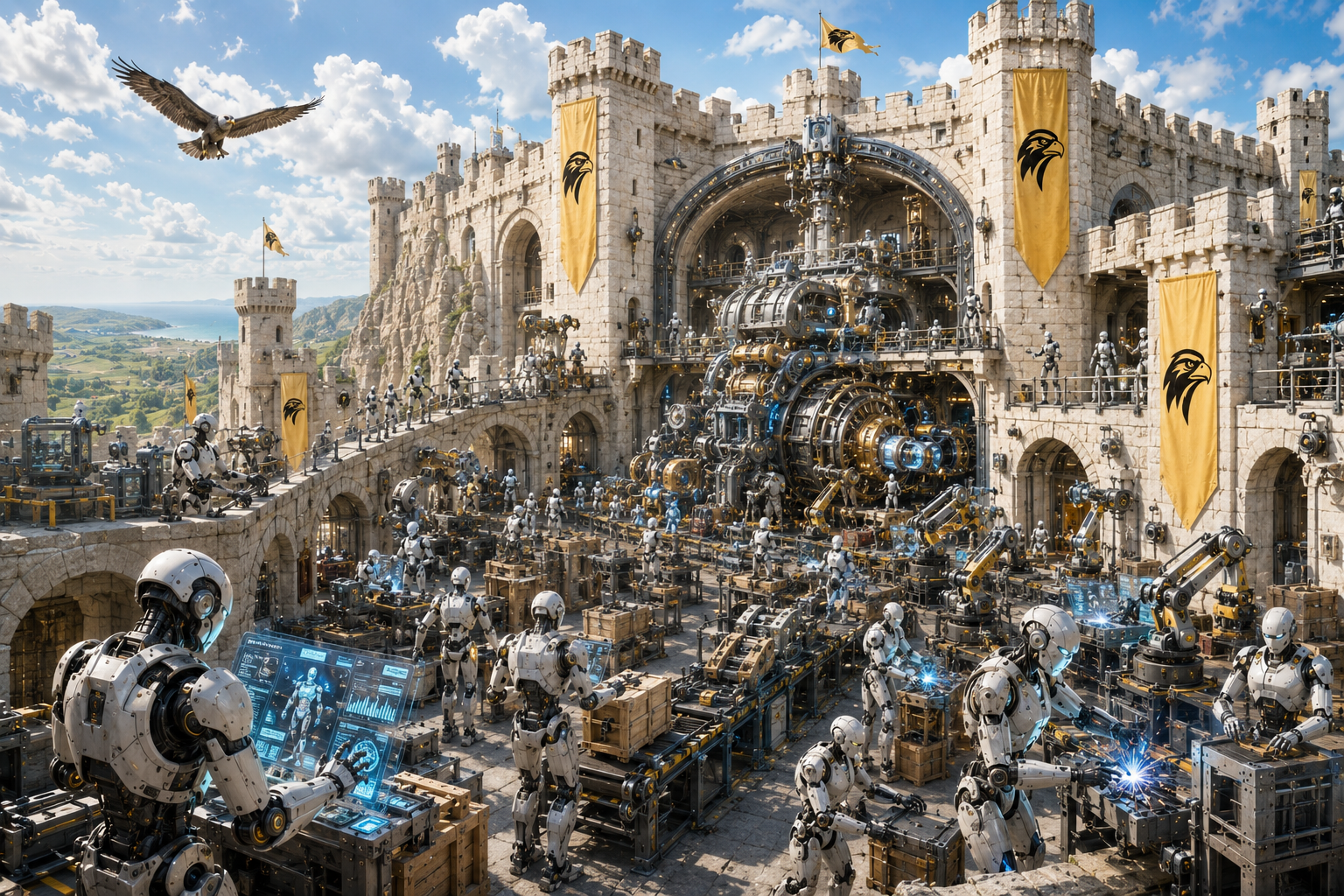
“Fortress-Strong Robotic platforms” ©2026. pitchhawk. All rights reserved.
The signal
Robots aren't science fiction anymore. They're in warehouses, operating theatres, factory floors, logistics networks, and if the numbers coming out of China are any guide, they are arriving everywhere else faster than almost anyone in the Western world has fully registered.
Physical automation combines AI, sensors, actuators, and mechanical systems to allow machines to do what previously required a human body. It is undergoing the most consequential capability inflection in its history. The convergence of dramatically cheaper sensors, AI models trained on physical world data, and rapid advances in actuator technology has compressed a decade of expected progress into roughly three years.
But the real story is not the technology. The real story is the commercial engine being built underneath it, and the extraordinary speed at which that engine is being assembled, particularly in one country that most Western founders and investors are still dramatically underestimating.
Signal. Physical automation has crossed from research novelty to commercial deployment. The investable signals look very different depending on which layer of the stack you examine, and China's dominance of the production layer is the single most important fact in this sector that Western capital has not yet fully priced in.
Why it matters
Three structural forces are converging on physical automation simultaneously, and each one is large enough on its own to sustain a multi-decade investment thesis.
The first is labour. Developed economies face persistent, structural labour shortages across manufacturing, logistics, healthcare, and agriculture. These aren't cyclical gaps that higher wages will close. They are demographic realities. Ageing workforces, declining birth rates, and the mismatch between where labour exists and where the work needs to be done are not problems that resolve themselves.
The second is reshoring. The 2025 tariff regime has forced manufacturers across every major sector to accelerate the return of production to North America and Europe. Building new factories in high-wage geographies without automation is economically impossible, creating a structural demand surge for robots that overlaps perfectly with the AI capability inflection. This is not a technology cycle. It is an economic necessity.
The third is AI convergence. For decades, industrial robots could only do what they were explicitly programmed to do. Fast, precise, and utterly inflexible. The integration of AI foundation models with physical hardware is changing that equation fundamentally. Robots trained on large datasets of physical world interactions are developing generalised manipulation, perception, and decision-making capabilities that make them genuinely useful in unstructured environments.
These three forces are not independent tailwinds. They are multiplicative. And the country that understood this earliest, and acted fastest, is not the United States.
The China factor, nobody is talking about
Here is the data point that stops every serious investor in their tracks.
China installed approximately 276,000 industrial robots in 2025, more than Japan, the United States, Germany, and South Korea combined.
Japan, the second-largest market, installed approximately 46,000 units. The United States installed approximately 35,000. China installs more industrial robots in a single quarter than most countries install in a year.
That is the established industrial base. Now add the humanoid layer.
Global humanoid robot shipments reached 13,318 units in 2025, up 465% from 2024. Chinese brands produced 87% of them. Shanghai-based AgiBot delivered over 5,100 humanoid units in 2025, nearly 40% of the global market. Unitree Robotics shipped around 4,200. China's Ministry of Industry and Information Technology projects 2026 full-year humanoid robot output to exceed 100,000 units, a fivefold leap from 2025.
The competitive parallel that every investor should hold in mind is the EV industry. The race between Unitree and AgiBot mirrors the early competitive dynamics between BYD and CATL in the EV space. China built its EV dominance through exactly this combination. Early government support, dense domestic supply chains, and rapid iteration cycles that Western competitors couldn't match. The same playbook is running again, at even greater speed, in physical robotics.
UBTECH Walker S2 units are already moving across the factory floors of BYD, Geely, FAW-Volkswagen, Dongfeng, Audi FAW, Foxconn, and SF Express, and Airbus signed on in January 2026 to bring them into aviation manufacturing. While Tesla's Optimus is still ramping and Figure AI is celebrating early commercial deployments, Chinese makers are shipping in the thousands, to real customers, in real production environments, today.
Unitree's R1 humanoid is now priced at $4,900, a figure analysts said was impossible just two years ago. When the cost of a humanoid robot approaches the cost of a year's human labour in a high-wage market, the commercial calculus for every manufacturer on earth changes permanently. That moment is closer than most Western capital allocation frameworks currently assume.
The investor angle, four very different commercial engines
Sophisticated investors are treating physical automation not as a single sector, but as a stack, with very different investment frameworks at each layer.
Amazon, the world's largest proof-of-concept
No company on earth better illustrates the commercial engine of physical automation than Amazon. In 2020, Amazon operated roughly 200,000 robots. By 2024, that number had grown to 750,000. In 2025, it crossed the 1 million mark. From 2025 through 2027, the company expects automation to generate $12.6 billion in savings.
Amazon's long-term objective is to automate roughly 75% of its operations.
But the Amazon story is more nuanced than cost savings. AWS revenue soared 28% to $37.6 billion in Q1 2026, the highest acceleration in 15 quarters. The connection between AWS and robotics is not coincidental. Automation savings are being recycled directly into AI infrastructure investment, which in turn powers the next generation of autonomous systems. Amazon is running a flywheel between physical automation and cloud compute that is structurally reinforcing. Each investment makes the next one more productive. A Morgan Stanley report estimated that if 30 to 40% of Amazon's orders in the U.S. are fulfilled through next-gen automated warehouses by 2030, the company could save $10 billion a year. That is not a cost-cutting story. That is a margin transformation story, and it is already underway.
Intuitive Surgical, a fortress-strength model
Intuitive Surgical is the canonical example of what a fortress-strength physical automation commercial engine looks like. High-margin, recurring revenue, razor-and-blades economics. Q1 2026 revenue grew 23% year-over-year to $2.77 billion, with recurring revenue, instruments, accessories, and services, now constituting 86% of total revenue.
The da Vinci surgical system holds over 90% market share in soft-tissue robotic surgery. The moat is real. FDA regulatory barriers, surgeon training costs, and hospital capital commitment cycles create switching costs that protect the economics for years after each system is installed. The da Vinci is used in roughly 3% of the surgeries globally that could benefit from robotic assistance. The penetration story is still in early innings. It is the answer to the question every robotics founder should be asking. What does my commercial engine look like in twenty years?
Drones, last-mile logistics reaches commercial reality
The aerial layer of physical automation deserves its own signal, but the key data points are instructive here. Zipline has surpassed 2 million commercial deliveries, raised $600 million at a $7.6 billion valuation, and is expanding to multiple US states in 2026. Alphabet's Wing plans to expand drone delivery to 100 Walmart Supercenters across five major US metropolitan areas by mid-2026, achieving sub-19-minute fulfilment times. The global drone delivery market is projected at $4.2 billion in 2026 and expected to exceed $12 billion by 2030. The businesses that own the commercial stack end-to-end, Zipline owns its aircraft, software, and delivery network, are building defensible positions before the market fully matures. That is the pattern every prior automation transition has followed.
The tipping point
Current-generation humanoid robots cost between $100,000 and $300,000 per unit, require significant integration engineering, and have uptime rates that are still improving.
Tesla's long-term target of $20,000 to $30,000 per Optimus unit is the commercial inflection that would open the mass market. Unitree's R1 at $4,900 suggests the Chinese cost curve is running well ahead of that timeline. Bank of America forecasts 90,000 humanoid shipments in 2026, rising to 1.2 million by 2030.
Three challenges remain constant regardless of platform or geography. Capital intensity, integration complexity, and business model clarity. Deploying robots in a factory is not a software installation. The integration cost is frequently the hidden variable that determines whether a commercial pilot becomes a commercial programme, or stays a proof-of-concept indefinitely. And selling a robot is a hardware transaction. Building a business on robotics requires recurring revenue. Service contracts, consumables, data, software subscriptions, or outcome-based pricing that generates cash flow beyond the initial sale.
Every humanoid robot demonstration has been followed by years of delays before commercial deployment. The gap between headline projection and operational reality has historically disappointed investors who priced in the optimistic scenario. That is not a reason to dismiss the thesis. It is a reason to invest in the commercial engine underneath the demonstration.
Founder challenge
If you're building, enabling, or monetising physical automation, whether that's humanoid robots, surgical systems, warehouse automation, agricultural robotics, drone logistics, or the sensors and software that make any of it work, the question that determines whether you leave the room with capital is not whether your machine can do something impressive.
🤖 Does your business model generate recurring revenue beyond the initial hardware sale, or does your entire commercial engine depend on a continuous stream of new unit sales at a price point that Chinese competitors are currently halving every 18 months?
🤖 What is your integration story? The robot is not the product or service. The deployed, operating, value-generating system is the product or service. How does your business capture the economics of that distinction?
🤖 Where does your moat come from in a sector where hardware costs are falling rapidly, Chinese manufacturers are scaling to 100,000 units per year, and every major technology company, Nvidia, Google, Amazon, Tesla, is simultaneously building foundational capabilities?
🤖 Have you stress-tested your capital requirements against the time it takes to go from commercial pilot to commercial programme, in a sector where a Chinese competitor may be shipping your product at one-tenth your cost before your next funding round closes?
The founders who answer those and similar questions with precision and confidence leave the room with capital. The ones who can't discover, too late, that a robot that can fold laundry in a demonstration is not the same thing as a commercial engine that holds under the scrutiny of someone who has seen the sector's full cycle.
How pitchhawk helps you answer those questions
At pitchhawk, we don't start with the pitch. We start by surveying what lies behind, beneath, and around it, the underlying business and investment thesis.
Using an outside-in, buy-side perspective, we diagnose whether a genuine investable fortress exists behind your innovation. We pressure-test the underlying business to reveal the structural signals professional investors recognise. Then we help fortify what already exists, build what's missing, and show you how to wrap it in an investment thesis that helps professional investors recognise what you've actually built.
In physical automation, that work is particularly revealing. The technology is extraordinary. The market is structural. The capital is moving, and in China it is moving at a speed and scale that redefines what competitive means. But the gap between a machine that works and a robotics business that is fundable at scale is defined not by what the robot can do, but by whether there is a commercial engine underneath it that holds under independent investor scrutiny, and is financially resilient to the China threat.
Our mission is simple. Helping founders transform innovations into Fortress-Strong, Investor-Ready (and Buyer-Ready) businesses that professional investors can recognise and confidently back.
🤖 Are you listening to the signal?
pitchhawk is.
Mike 🖐

Innovation rarely stalls because of a lack of ideas.
It stalls in the gap between a great innovation and a fortress-strong investable business.
That gap never closed because nobody was incentivised to provide founders with an independent investor's lens.
pitchhawk is.
© pitchhawk, 2025-6. All rights reserved. You may not copy, reproduce or imitate our services, content, frameworks or intellectual property.