
Investor Signals #13: Defence Tech, the procurement valley and the capital mismatch
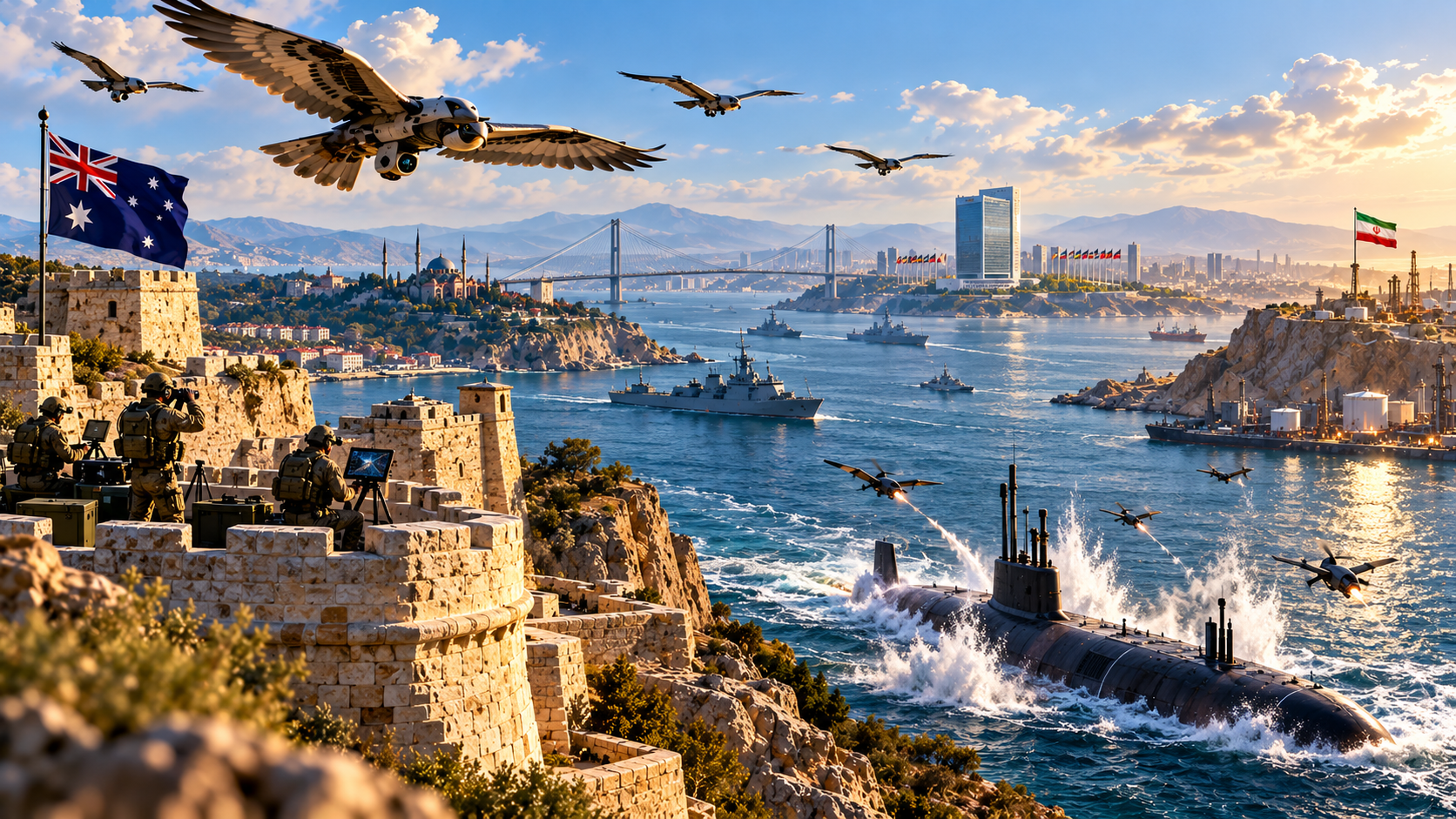
“Sovereign Hawk” ©2026. pitchhawk. All rights reserved.
The signal 🚩
Last week, Perth hosted Land Forces 2026 for the first time. Australia’s largest land defence exposition brought together almost 1,000 exhibiting organisations and thousands of delegates from 60 countries, spanning the Indo-Pacific, Europe, Asia, and North America. Military leaders, government ministers, researchers, product builders, creatives, supporters, and industry executives converged on the Perth Convention and Exhibition Centre for three days. Delegates toured the Australian Marine Complex at Henderson and the Australian Automation and Robotics Precinct at Neerabup. It was, by any measure, one of the largest gatherings of defence capital and procurement intent ever held on Australian soil.
In Australia, the largest source of early-stage innovation capital is not a fund manager. It is the federal government’s R&D Tax Incentive, which in the past has paid out $3.5 billion in refundable offsets to more than 10,000 companies in a single year. That’s right, it’s you and me, the taxpayers, who provide the biggest slither of innovation funding. Not VC funds!
After that comes the capital written by family offices and high net worth investors, whose ability to set their own investment parameters outside institutional ESG frameworks makes them the most flexible source of venture cheques in the market.
Dedicated VC funds come third, and in defence tech specifically, that pool is almost non-existent. In fact, the only dedicated defence tech venture fund in Australia, Steve Baxter’s Beaten Zone, took 1,800 meetings to close at $26 million. Reportedly, Baxter put in $6 million of his own capital to anchor it.
Sovereign wealth funds and the superannuation system, which together represent the largest pools of long-duration capital in the country, have been almost entirely absent, and the institutional capital that could actually match the timeline of a 10-year program of record has not yet decided whether defence is acceptable!
That is a massive gap. And that massive gap is definitely not an anomaly. It is the signal 🚩
Signal. Defence tech is not a niche investment category. It is the commercial expression of a strategic imperative that three geopolitical events in five years have made impossible to defer. The founders building at the intersection of autonomous systems, AI, cyber, advanced sensing, and sovereign supply chain security are building the infrastructure of national survival. The investors who understand the procurement cycle, match their capital to the program timeline, and position their cheques as sovereign solutions rather than technology bets are the ones who will capture the returns. The ones who arrive with venture timelines and lab demonstrations are the ones who will populate the graveyard.
Why it matters
Three events restructured the global defence investment landscape in under five years and created the demand signal that Land Forces 2026 was responding to.
Russia-Ukraine. 📅 February 2022. European NATO members were averaging 1.6% of GDP on defence, mostly ignoring the 2% target they had nominally committed to for years. The invasion changed the political calculus overnight. By 2025 Europe and Canada had increased defence spending 20% year on year. Global military spending reached a record $2.9 trillion. Europe’s ReArm Europe plan committed €800 billion through to 2030. But Ukraine did something equally important for the technology investor. It validated specific technologies at battlefield scale and at a pace that traditional procurement bureaucracies had never previously achieved. Drones, autonomous systems, electronic warfare, and counter-drone capabilities were iterated in weeks, not the years a defence acquisition cycle normally requires. Ukraine became the world’s fastest defence product development environment. The technology that survived there carries a credibility premium in every procurement conversation that no laboratory demonstration can match.
Trump and NATO. 📅 January 2025. Trump’s public questioning of the U.S. commitment to NATO’s Article 5 guarantee removed the last political obstacle to European rearmament. If the U.S. could not be assumed to defend Europe, Europe needed to defend itself. Defence budgets that had been politically difficult to increase became politically impossible not to increase. Germany broke its constitutional debt brake. Poland committed 5% of GDP to defence. The UK committed to 2.5%. The ESG constraints that had kept institutional capital out of European defence began to erode at the same moment. Germany’s Kenfo sovereign fund lifted its hard exclusion on defence companies. Norway’s $1.8 trillion GPFG is under intense political pressure to do the same, having watched BAE Systems rise 35% and Rheinmetall rise 115% while its own ethical investment framework kept it on the sidelines. The argument that excluding defence from an investment portfolio is an ethical position was harder to sustain when the alternative was European strategic dependency on an uncertain ally.
Iran 2026. 📅 U.S. and Israeli strikes on Iran in early 2026 closed the Strait of Hormuz. Brent crude went from $72 to $112 per barrel in under a month. Qatar declared force majeure on LNG. The ECB postponed planned rate cuts and warned of stagflation. U.S. munitions stockpiles were stretched to the point where EU Defence Commissioner Andrius Kubilius publicly stated that the U.S. was becoming unable to supply both its Gulf allies and Ukraine simultaneously. The message to every allied government was unambiguous. Sovereign munitions capacity, autonomous systems, and supply chain independence were not strategic planning documents. They were operational requirements with a deadline that had just moved considerably closer.
Perhaps surprisingly, Australia read all three signals. The $12 billion Henderson commitment, the $500 million co-investment plan seeking private capital partners, and Land Forces coming to Perth for the first time are some of the direct results.
The graveyard, what failed and why
Understanding the defence tech graveyard requires understanding the Technology Readiness Level framework the Pentagon uses to assess whether a technology is ready for procurement. TRL runs from 1, basic principles observed, to 9, system proven in an operational environment.
Most defence tech startups enter procurement conversations at TRL 4 to 6, technology validated in a laboratory or relevant environment. Programmes of record typically require TRL 7 to 9, system demonstrated in an operational environment with a validated manufacturing process behind it.
The valley between TRL 6 and TRL 7 is where most defence tech companies die. Not because the technology fails. Because the capital required to cross it runs out before the procurement decision lands.
A company at TRL 6 with investors expecting returns in year 4 and a program of record 6 years away has a structural problem that no amount of successful demonstration resolves!
At pitchhawk we developed the pitchhawk readiness level (PRL)®, which maps business investability in a conceptually similar way that TRL maps technology deployability.
A TRL 6 company with a PRL 3 investment thesis is the defence tech graveyard in one sentence.
The U.S. picture. The most mature ecosystem in the world, but still full of failures in the middle. The U.S. built a parallel procurement infrastructure specifically designed to move venture-backed startups through the TRL valley. DIU, AFWERX, SBIR awards from $50,000 to $300,000, Other Transaction Authority agreements from $1 million to $50 million, before a program of record at $50 million to $1 billion plus. The procurement cycle still runs 12 to 36 months from OTA to program of record. Companies that raised at high valuations on the strength of an SBIR award, won an OTA, and then waited 4 years for a program of record discovered their fund timeline and their procurement timeline were running on entirely different clocks 🤦♀️ but the survivors, Anduril at a $61 billion valuation, Shield AI at $12.7 billion, Palantir at approximately $330 billion, crossed TRL 9 with signed revenue before their investors needed returns.
The European picture. Fragmented national procurement across 27 frameworks. No European equivalent of DIU or AFWERX. Large primes, Airbus, Thales, BAE Systems, Leonardo, dominating procurement relationships and making it structurally difficult for startups to break in. In Germany, startups win pilots and field trials but cannot convert them to funded programs despite a defence budget above €100 billion. In the UK, 4% of MoD direct domestic spending reached SMEs in 2024/25. Helsing at €1.8 billion is the exception that proves the rule. The European graveyard is full of companies that demonstrated successfully at TRL 6 and ran out of capital waiting for TRL 9 procurement decisions.
The Australian and AUKUS picture. Australia has sovereign intent at unprecedented scale and a capital market that was almost entirely absent until very recently. The AUKUS Pillar 2 pathway moves through innovation grants, field trials, and demonstrations before a program of record that may be 5 to 7 years from the first dollar of private capital invested. The R&D tax offset provides the earliest-stage support. Family offices and high net worth investors write the next cheques, when they can navigate their own ESG positions. Dedicated VC fund capital is almost non-existent. Beaten Zone at $26 million is the entire dedicated fund landscape.
And then there is the strategic question the submarine commitment is forcing into the open. Australia committed A$368 billion, approximately US$245 billion in constant 2022-23 dollars, to AUKUS Pillar 1 submarines. Virginia-class boats at A$3 billion each. SSN-AUKUS boats at A$6-$8 billion each. The first Australian-built boat will not be delivered until the early 2040s. WT? And the program runs to the 2060s.
Meanwhile, a LUCAS drone, a one-way autonomous attack system reverse-engineered from an Iranian Shahed-136, costs approximately $35,000 per unit against $2.5 million for a Tomahawk missile. Seventy times cheaper. Ukraine demonstrated at scale that swarms of expendable autonomous systems can defeat platforms that cost thousands of times more. CENTCOM’s commander called LUCAS indispensable after its first operational use in 2026. The U.S. Replicator initiative is targeting mass deployment of one-way attack systems across military units by end 2026.
The strategic question Australia’s defence investment community is beginning to ask openly is whether a $368 billion investment in nuclear submarines optimised for Cold War deterrence is the right primary bet in a warfare environment increasingly defined by cheap, mass-producible, sacrificial autonomous systems.
That question is not a reason to oppose AUKUS. But it is a reason to understand precisely which defence tech investments sit on the right side of the trajectory that Ukraine, Iran, and Replicator have revealed.
The investor angle, where professional capital is concentrating
🛡️ U.S. software-first primes and their supply chains. Anduril, Shield AI, Palantir, and the tier below them are past TRL 9 with signed revenue and program of record in place. The capital concentrating here is growth equity, not venture. a16z American Dynamism, Founders Fund, General Catalyst, and 8VC have already made their entries. The opportunity for Australian investors is not to back these companies directly. It is to identify the Australian businesses building technology that these primes and the DoD programmes behind them will need, and to position those businesses as sovereign supply chain solutions before the procurement conversations begin.
🛡️ Autonomous and drone systems. The fastest-growing investment category globally in 2025, with $4.7 billion in drone-focused deals alone. Battlefield validation from Ukraine and the Iran conflict. The U.S. Replicator initiative, Australia’s investment in the Neerabup robotics precinct, and the Henderson autonomous undersea vessel program are all active demand signals. The investable businesses are the ones with manufacturing scale and a path to mass production, not just working prototypes at TRL 5.
🛡️ European dual-use. Dual-use companies building technology with both commercial and defence applications are the accessible entry point for ESG-constrained institutional capital. The EU framework explicitly does not prohibit defence or dual-use investment. Lakestar’s €300 million vehicle, AVP and Earlybird’s €500 million E2D fund, and the EU Defence Equity Facility at €161 million are the structural enablers of a capital unlock that is still in its early stages.
🛡️ AUKUS Pillar 2 Australia. AI, autonomy, quantum, advanced sensing, cyber, and undersea warfare are the six technology pillars the Australian government has explicitly flagged for co-investment. The $500 million co-investment plan is actively seeking fund managers. Beaten Zone is the only dedicated vehicle at $26 million. The superannuation system manages over $4 trillion. The mismatch between available sovereign-backed opportunity and deployed private capital is the most visible structural gap in the Australian investment market right now. The family offices and high net worth investors who move first, with investment structures matched to program timelines rather than conventional fund cycles, are the ones who will capture the asymmetric upside.
🛡️ Procurement bridging capital. The gap that kills defence tech companies is not seed or Series A. It is the patient capital required to hold a business through the TRL 6 to TRL 9 journey and the 3 to 7 year valley between a successful field trial and a funded program of record. This is not venture capital work. It is mezzanine or patient equity work, matched to the procurement timeline rather than a fund deployment cycle. Sovereign co-investment structures, where government capital sits alongside private capital with compatible holding periods, are the emerging instrument. The investors building these structures now are building the architecture that the sector requires and that does not yet exist at meaningful scale in Australia.
A note on the submarine question
The AUKUS submarine commitment deserves a direct mention for the founders and investors building in Australian defence tech, because the debate around it is shaping procurement priorities in ways that matter.
The $368 billion program is not going away. The strategic rationale for nuclear submarine capability in Australia’s threat environment is genuine. But the Iran conflict, the Ukraine battlefield, and the Replicator initiative have accelerated a shift in procurement thinking that is visible to anyone paying attention. The technologies attracting the fastest-growing procurement interest globally, autonomous systems, electronic warfare, counter-drone, AI-enabled decision-making, low-cost expendable strike, are not the technologies that a submarine program funds. They are the technologies AUKUS Pillar 2 funds. The founders who have positioned their businesses in the Pillar 2 technology pillars, with sovereign structure and a clear program of record pathway, are building in the highest-priority and most rapidly funded part of the Australian defence investment landscape. The submarine will be built. The autonomous systems that operate around it, protect it, and extend its reach are the commercial opportunity.
The tipping point, professional investor tests
The defence tech sector has crossed a threshold. The three geopolitical events that restructured global defence budgets have also restructured investor frameworks. Now, defence tech must pass a number of critical tests.
🛡️ Battlefield or operational validation, TRL 7 or above. TRL 6 gets you into a conversation. TRL 9 gets you a contract. Has the technology been tested in a live or near-live operational environment? A system demonstrated in Ukraine, validated in an AUKUS field trial, or operationally proven in the Iran conflict carries a procurement credibility that no laboratory result can replicate. The investors backing defence tech businesses in 2026 are backing companies that have already crossed this threshold or have a funded, credible pathway to it.
🛡️ Pathway to program of record. Does the business have a documented, credible pathway from its current TRL to a program of record within a timeline that matches its capital structure? A company at TRL 6 with patient equity holding through a 7-year procurement pathway is a fundable business. The same company with VC capital needing returns in year 4 is not. The ones that answer this question with precision, naming the program, the timeline, the decision-makers and the capital structure that holds through it, are likely to win.
🛡️ Sovereign structure and clearance. Is the business structured as a sovereign supply chain solution? ITAR compliance where relevant. Appropriate ownership structures. Security clearances at the level the program requires. National industrial base credentials. Foreign ownership on a defence tech share register does not just raise ethical questions. In the U.S. context it raises CFIUS and FOCI questions that can end a program of record conversation before it starts. In Australia the equivalent questions are emerging as Henderson and AUKUS procurement frameworks mature. The businesses that have built the wrapper before they need it are the ones that do not discover it as a fatal gap in the middle of a process to raise capital.
🛡️ Capital structure matched to procurement timeline. The same test that runs through every Investor Signal in this series. In defence tech it is most acute because the mismatch is most severe. A processing facility in critical minerals might need 10 to 15 years of patient equity. A program of record in defence might need 7. Neither of those timelines is compatible with a standard VC fund structure. The family offices, corporate VCs, and sovereign co-investment vehicles that build instruments matched to procurement timelines are not just filling a gap. They are building the infrastructure the sector requires to function. The founders who understand which type of capital their program actually needs, and who arrive at the capital conversation with that understanding already built into their investment thesis and timeline, are the ones most likely to leave the room with a smile.
Founder challenge
If you are building in Australian defence tech, whether that is autonomous systems, electronic warfare, cyber, quantum, advanced sensing, AI-enabled decision-making, or the sovereign manufacturing capability that sits behind all of it, the question every professional capital partner will ask is not whether your technology works.
🛡️ What is your TRL? Have you mapped the capital requirements of each stage of your journey from current TRL to program of record, and have you matched each stage to the right type of capital?
🛡️ Do you have a signed pathway to a program of record, or a letter of intent that has not yet become a contract? The procurement valley runs 3 to 7 years. What does your capital structure look like at year 5, and have you had that conversation with your existing investors before the valley arrives?
🛡️ Is your business structured for sovereign procurement? Ownership, clearances, ITAR compliance where relevant, national industrial base credentials. These are not administrative boxes. They are commercial prerequisites that take time to build and cannot be retrofitted quickly when a procurement decision is imminent. Have you built the wrapper before you need it?
Bust most of all 👇👇👇
🛡️ Are you building for the warfare model that is arriving or the one that is leaving? A $35,000 autonomous sacrificial drone used operationally in 2026 against a target that a $2.5 million Tomahawk would previously have been required for is a signal about where procurement priorities are heading. The founders building mass-producible, software-defined, expendable autonomous systems, and the sovereign manufacturing capability to produce them at scale in Australia, are building for the decade that is arriving. The ones building for the decade that is leaving are building for a procurement cycle that will shrink, not grow.
The founders who answer those questions with evidence, who arrive with a commercial engine built around the realities of defence procurement rather than the assumptions of commercial venture, leave the room smiling. The ones who arrive with a compelling technology demonstration but without a procurement pathway, a matched capital structure, and a sovereign wrapper discover that the distance between a successful field trial and a funded program of record is where most of the sector’s capital has been destroyed.
How pitchhawk helps you answer those questions
At pitchhawk, we don’t start with your pitch.
📢
We start with your underlying business and investment thesis. Using an outside-in, buy-side perspective, we diagnose whether you've been able to transform your innovation into a fortified and investable business. We pressure-test the commercial engine to see if it’s firing or missing, whether revenue can repeat, whether economics can scale, whether the moat can hold, whether the risks are understood and whether the investment thesis is supported by evidence rather than assumptions. Then we help fortify what already exists, build what's missing, and show you how to wrap it in an investment thesis that helps professional investors recognise what you've actually built.
In defence tech, that work is revealing. The TRL-to-PRL gap. The mismatch between procurement timelines and capital structures. The sovereign wrapper that separates a technology demonstration from a fundable program of record. They are the exact problems pitchhawk was built to diagnose and close.
The businesses that survive the procurement valley do so because they built their commercial engines and investment cases around the realities of the sector before they sought capital, not after discovering them mid-raise.
Our mission is simple. Helping innovation-led business builders transform their innovations into Fortress-Strong, Investor-Ready businesses that professional investors can quickly recognise and confidently back.
🛡️ Are you listening to the signal?
pitchhawk is.
Mike 🖐

Innovation rarely stalls because of a lack of ideas.
It stalls in the gap between a great innovation and a fortress-strength investable business.
That gap never closed because nobody was incentivised to see the business through an independent investor's lens.
pitchhawk is.
© pitchhawk®, 2025-6. All rights reserved. You may not copy, reproduce or imitate our services, content, frameworks or intellectual property.