
Investor signals #12: Critical Minerals, the “everything” supply chain
“Critical Hawk” ©2026. pitchhawk. All rights reserved.
The signal
In March 2023, the only cobalt mine in the U.S. was mothballed weeks before it was due to open. Jervois Global had invested $150 million to build Idaho Cobalt Operations. It laid off approximately 250 workers. The mine had never produced a single tonne of commercial cobalt.
The price of cobalt had fallen 72% from its April 2022 peak. China Molybdenum Company had nearly doubled its annual cobalt production, flooding the market while prices collapsed. By early 2025, Jervois filed for bankruptcy. AustralianSuper, the largest pension fund here in Australia, lost its entire $100 million investment.
In Western Australia, BHP suspended its Nickel West operations until at least 2027, writing down $5.4 billion in nickel assets. A wave of Indonesian supply, backed by Chinese interests, had collapsed LME nickel prices by 69.5% between March 2022 and December 2025.
In lithium, battery grade lithium carbonate peaked at approximately $80,000 to $85,000 per tonne in November 2022. It fell more than 80% to below $14,000 per tonne by late 2025. And spodumene FOB Australia collapsed from $6,401 per tonne in December 2022 to $818 per tonne by September 2024, an 87% fall. Dozens of junior lithium miners on the ASX were effectively wiped out. Notable, LME Lithium Hydroxide CIF is still ~58% down from its July 2023 peak.
Three minerals. Three boom-bust cycles. Three industries devastated not by a failure of demand but by a single strategic actor weaponising its control of the supply chain to defend its market position.
That actor is China.
Signal. Critical minerals are not a mining story. They are the supply chain underneath every technology sector in this series, from AI infrastructure and renewable energy to defence, robotics, water technology, and the clean economy. The “everything” supply chain. The race to build that supply chain outside China is the decade-defining industrial investment of our time. And Australia, sitting on one of the most strategically significant mineral endowments on earth, is at the centre of it.
Why it matters 🚨
Every sector covered in the Investor Signals series depends on critical minerals in ways that most investors have not fully mapped.
AI data centres require copper. A single conventional data centre uses 5,000 to 15,000 tonnes of copper. By 2030, data centres alone will consume between 330,000 and 1.1 million tonnes of copper annually. The International Copper Study Group projects a refined copper shortfall of 150,000 tonnes in 2026 alone.
Solar panels require silver. Global solar installations reached 655 gigawatts in 2025. Silver is now in its sixth consecutive year of structural supply deficit. The cumulative deficit from 2021 to 2025 reached approximately 820 million ounces. Silver's price more than doubled in 2025, hitting $121.62 per ounce in January 2026. AI data centres now consume over 42.3 million ounces of silver annually, more than 10% of total global electrical and electronics silver demand. Around 72% of primary silver is produced as a byproduct of copper, lead, and zinc mining, meaning supply cannot be easily increased independently of those markets.
Electric vehicles require lithium, cobalt, nickel, manganese, and graphite. Wind turbines require rare earth elements for their permanent magnets. Defence systems from guided missiles to fighter jets to submarines require rare earth elements with no substitutes at the precision required. Semiconductors require gallium and germanium, both of which China has placed on export restriction lists as bargaining chips in the broader geopolitical contest.
In January 2026, NextLevelCorporate published an analysis arguing that geopolitical competition between the U.S. and China in chips, compute, energy, and strategic minerals would be the primary growth engine of the coming decade.
That thesis has been validated at speed. The $1.2 billion Australian Critical Minerals Strategic Reserve, Apple's $500 million investment in MP Materials, the U.S. DoD's $439 million in rare earth processing contracts, and a $13 billion pipeline of critical minerals projects underpinned by the Australia-U.S. bilateral agreement signed in October 2025 are all direct expressions of that thesis becoming policy.
The question for founders and investors is not whether critical minerals matter. They are the physical substrate of the digital and clean economy. The question is how to build a fundable business in a sector where sovereign capital, geopolitical timing, and processing infrastructure are as important as ore grade.
The graveyard, what failed and why
The critical minerals graveyard between 2022 and 2025 is one of the most instructive in the Investor Signals series, because the failure mode is specific, documented, and repeatable.
The pattern runs consistently. A critical mineral enters a demand super cycle. Prices rise dramatically. Western miners, junior explorers, and investors pile in, committing capital based on feasibility studies that assume prices remain elevated. China, whose state-backed producers have lower costs and longer time horizons, increases production to defend market share. Prices collapse. Western projects become uneconomic. Capital is destroyed. The Chinese position is strengthened.
Cobalt. Jervois Idaho. $150 million invested. Zero commercial production. Cobalt fell 72% from its April 2022 peak as China Molybdenum nearly doubled its cobalt output from the Democratic Republic of Congo. The mine needed cobalt at $20 per pound to reopen. It has been mothballed ever since. Bankruptcy followed in early 2025, wiping out AustralianSuper's $100 million.
Nickel. The Indonesia story is the most instructive, and it was visible in the data years before the capital destruction landed. Indonesia was already producing 1.6 million tonnes of nickel annually against Australia's 160,000 tonnes, a 10 to 1 ratio, before Chinese HPAL technology had reached full scale. In 2023, NextLevelCorporate presented an analysis to a firm of valuers using production data that laid out precisely what was so strategically attractive about that combination.
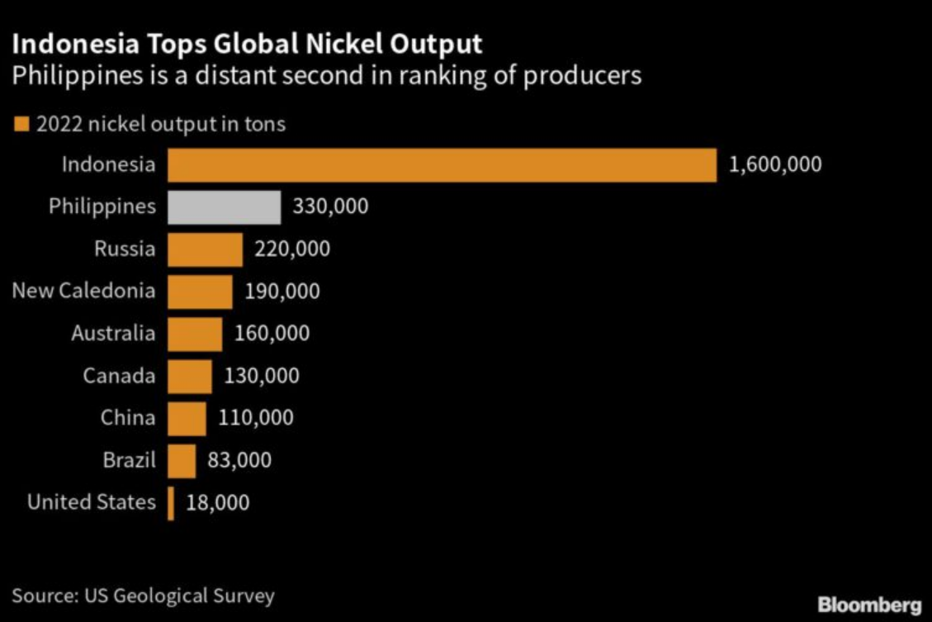
Source: Bloomberg. The Nickel landscape in 2022.
The figures required no commentary. When China identifies a resource endowment of that magnitude in an accessible jurisdiction, it deploys capital to develop the processing technology, builds the infrastructure, and uses the resulting supply position to set market prices on its own terms.
That analysis proved correct. China's Tsingshan Holding Group had deployed $700 million from 2018 to apply High-Pressure Acid Leaching technology to Indonesian laterite deposits, unlocking a wave of new battery-grade supply. LME nickel prices collapsed 69.5% between March 2022 and December 2025.
BHP wrote down $5.4 billion and suspended Nickel West until at least 2027. Wyloo Metals closed its Kambalda nickel assets. Dozens of Australian nickel operations moved to care and maintenance. Indonesia, having driven competitors out, has now cut its 2026 nickel production quotas by approximately 30%, targeting price recovery from a position of unchallenged supply dominance. And investors piled into Nickel Industries, an ASX listed Nickel miner, based in Indonesia.
Lithium. An 80 to 87% price collapse across lithium carbonate and spodumene from peak to trough. Dozens of ASX-listed junior lithium miners effectively wiped out before reaching production. MP Materials, the operator of the only rare earth mine and processing facility in the United States, swung from a $289 million net income in 2022 to a $65 million loss in 2024, surviving only because a Department of Defence offtake agreement ended its exposure to spot prices. More recently, things are perking up for lithium.
The playbook was not hidden. It was visible in the data before the consequences landed. The businesses that survived did so because they had locked in demand-side certainty before the cycle turned. The ones without sovereign backing or contracted offtake at agreed prices did not.
The rare earth processing chain, why ore is just the beginning
Most commentary on rare earths focuses on mining. The real story is everything that happens after the ore leaves the ground, because that is the layer China controls most completely and the layer where the value is highest.
The full processing chain runs through five distinct stages. Ore is mined and concentrated. That concentrate is chemically separated into individual rare earth oxides, or REO. The oxides are metallised, converted from oxide into metal. The metals are alloyed to achieve the magnetic properties required. That alloy, typically in strip-cast form, feeds a magnet plant which sinters and magnetises the material into the permanent magnets used in EV motors, wind turbines, defence systems, and industrial machinery. Hey presto.
China controls the majority of capacity at every single one of those stages. The further downstream, the tighter the grip. China controls approximately 90% of rare earth separation and refining capacity, approximately 94% of sintered permanent magnet production, and approximately 97% of heavy rare earth oxide separation capacity.
A new mine outside China without a funded, credible processing pathway is not a supply chain solution. It is a source of concentrate with an uncertain destination. This is the insight most investors miss. And it is why the businesses worth watching are not the miners. They are the processors. Some of which are now being vertically integrated into miners.
The investor angle, where professional capital is concentrating
⚗️ Copper, the most immediate structural deficit. Copper sits at the intersection of every major demand theme in this series simultaneously. Grid replacement/modernisation, EV production, AI data centres, and defence infrastructure all require copper at scale.
The International Copper Study Group projects a refined copper shortfall of 150,000 tonnes in 2026 alone, growing toward a structural deficit that analysts at JPMorgan project driving prices to $12,500 to $13,000 per tonne. Unlike rare earths, copper processing is geographically distributed and China does not hold a processing monopoly. The investment opportunity is in the businesses solving exploration efficiency, processing throughput, and supply chain transparency.
⚗️ Silver, the quiet strategic metal. Silver is in its sixth consecutive year of supply deficit, and the demand drivers are multiplying. Solar PV, AI data centres, EV components, and defence electronics are all simultaneously increasing demand for a metal whose supply is structurally constrained because 72% of it is produced as a byproduct of copper, lead, and zinc mining. Professional investors are treating silver less as a precious metal and more as a strategic industrial metal with a structural supply gap that cannot be resolved quickly regardless of price signals.
⚗️ Rare earth processing, the most defensible position outside China. The businesses attracting the most strategically patient capital are not the miners. They are the processors. MP Materials, NYSE: MP, operates the only rare earth mine and processing facility in the United States at Mountain Pass in California. It commissioned rare earth separation in 2023, began commercial NdPr metal production at its Fort Worth Texas facility in 2024, and produced its first finished neodymium-iron-boron magnets in 2025. It is the first company outside China operating an integrated mine-to-magnet supply chain at commercial scale. Apple's $500 million investment and a DoD offtake agreement have structurally de-risked the business through the price cycle.
USA Rare Earth, Nasdaq: USAR, acquired Less Common Metals, or LCM, in November 2025. LCM is based in Cheshire, UK, and is the only proven ex-China producer of rare earth metal, alloys, and strip casting at commercial scale, serving European, Japanese, and North American defence contractors and permanent magnet manufacturers. Less Common Metals was also a client of our sister advisory, NextLevelCorporate, giving NLC direct operational insight into the metallising and alloying layer of the supply chain well before Western governments were beginning to understand how dependent they were on Chinese processing capability at every stage downstream of the mine. USA Rare Earth is building magnet facilities in Oklahoma and South Carolina targeting 10,000 tonnes per year of NdFeB magnets by 2028, and a metal and alloy plant in Lacq, France co-located with Carester's Caremag oxide processing facility.
Lynas Rare Earths, ASX: LYC, mines at Mt Weld in Western Australia, the highest grade known rare earth deposit outside China. In May 2025 it became the first and only commercial producer of separated heavy rare earth oxides, dysprosium and terbium, outside China. It is building a Texas processing facility backed by U.S. DoD funding and expanding processing capability at Kalgoorlie in Western Australia.
Arafura Rare Earths, ASX: ARU, reached Final Investment Decision on its Nolans Project in the Northern Territory in May 2026, directly triggered by eligibility for the Australian Critical Minerals Strategic Reserve. Iluka Resources, ASX: ILU, is building Australia's first fully integrated rare earth refinery at Eneabba in Western Australia, backed by a $1.25 billion Australian Government loan, and Hancock.
Even with all of these players fully operational, ex-China refining capacity is likely to remain well below 20% of global supply through 2028. The January 2027 prohibition on Chinese-origin rare earth magnets in U.S. defence supply chains is the hard deadline concentrating capital with an urgency not seen in the sector before.
⚗️ The sovereign capital gap, where the money is and is not. The headline numbers are impressive. U.S. EXIM has committed to deploy up to $100 billion in critical minerals, energy, and supply chain security. The Australian government has committed $1.2 billion in the Critical Minerals Strategic Reserve, $7 billion in production tax incentives, and $5 billion through the Critical Minerals Facility. France has backed Caremag at Lacq with €106 million alongside €110 million from Japanese government partners JOGMEC and Iwatani. Public financing commitments for critical minerals projects more than quadrupled globally between 2023 and 2025.
But the IEA's Global Critical Minerals Outlook 2026 reported that actual investment in mining and refining fell 9% in 2025.
U.S. EXIM's largest commitments have concentrated in copper, lithium, and graphite at the mining stage. The downstream processing layers, metallising, alloying, and magnet manufacturing, have received far less binding capital. Most EXIM support remains non-binding Letters of Interest rather than signed loan agreements. That distinction is not semantic. A Letter of Interest does not add to bankability. It generally produces a yawn from most bankers. A signed agreement is what’s needed. Australia has backed Iluka and Arafura. The metallising, alloying, and magnet stages that sit downstream of those facilities remain largely without sovereign backing. France has done one genuinely integrated thing at Lacq. Brazil holds the world's second-largest reserves but has no industrial rare earth separation plant in operation.
The deeper problem is structural. Sovereign capital programmes are administered by departments that understand geopolitics but have limited capacity to analyse at precisely which stage in the processing chain a project most needs capital, and in what form.
The gap between a government announcing support for critical minerals and a government structuring a credit facility that allows a rare earth metallising plant to reach financial close is enormous. And that gap is where projects stall and die, but not before wiping out early investors.
⚗️ Lithium and battery minerals recycling, the recovery plays. Lithium’s 2022 peak of approximately $84,000 per tonne for carbonate felt like a new normal to the investors who committed capital on the back of it. By late 2025 the price had fallen more than 80%. By September 2026 it had fallen further still, to approximately $18,300 per tonne, the lowest close in nine months. A metal that had recovered strongly through the first half of 2026 gave back almost all of those gains in a single month. The September collapse was instructive because the trigger was not a demand shock. China's largest lithium mine went to care and maintenance after regulators revoked its environmental approval. That removed supply. Prices should have risen. Instead a methodological change at a Chinese price reporting agency revealed stockpiles more than twice the size previously reported. The market repriced immediately and kept falling. Albemarle and Ganfeng Lithium each lost more than a fifth of their value in the month. Both now trade at less than half their 52-week highs.
The lesson the lithium cycle keeps teaching is the same one cobalt and nickel taught before it. When China controls the inventory data, the processing infrastructure, and the ability to move reported stockpiles with an accounting change, price certainty for a Western producer is an illusion without sovereign offtake at agreed prices locking in the commercial engine before capital is spent.
The question professional investors are asking across every one of these sub-sectors is the same.
“Which businesses have built a commercial engine that holds under a Chinese price suppression scenario, owns or controls the processing layer that matters, and has matched its capital structure to the timeline its asset actually requires?”
⚗️ A note on hydrogen
While white hydrogen (geologic hydrogen and helium) might be a bit early, green hydrogen deserves a direct mention because of its relevance to Australia and to the companies and founders building in this space. The thesis is not wrong. It is early. Electrolysers require platinum group metals. The cost curve has not fallen fast enough, and the commercial models have not yet achieved the self-sustaining economics that would make green hydrogen fundable without ongoing sovereign support at scale. That does not make it uninvestable. It makes it a thesis requiring sovereign capital with infrastructure-grade timelines, patient equity, and a development finance structure that can hold through a decade-long cost compression curve. The technology is real. The commercial engine is still being built. The founders who understand which type of capital their project actually requires, and arrive with the right story for that capital, are the ones who make progress.
The tipping point, four tests professional investors are applying right now
The critical minerals sector has crossed a threshold. Sovereign capital, defence procurement, and strategic corporate investment are all actively deploying into supply chain solutions outside China. The question professional investors are applying to every project in front of them is whether it passes four specific tests before capital is committed.
⚗️ Price cycle survival. Does the commercial engine hold at trough prices, not just peak prices? The cobalt, nickel, and lithium graveyards are full of projects that were viable at 2022 prices and unviable at 2024 prices. Professional investors now stress-test every critical mineral project against a Chinese price suppression scenario before they commit. A project with conditional offtakes at agreed prices, sovereign price floor mechanisms, or DoD contract certainty passes this test, although whether this makes the project sustainable over the long term once support is removed is an entirely different question. A project dependent on spot prices at the moment it needs capital most does not 🚩
⚗️ Processing ownership. Does the business own, control, or have guaranteed access to the full processing chain? A mine without a funded processing pathway is not a supply chain solution. The investors backing MP Materials, USA Rare Earth, Lynas, Arafura, and Iluka are backing integrated processing chains, not ore bodies. Mine to magnet is not ambition. It is the minimum credible position for a genuinely investable supply chain outside China. Governments know this but are not yet sophisticated enough to help where and when it counts 🚩
⚗️ Capital structure alignment. Is the equity, mezzanine, and senior debt structured against investors and lenders whose holding period matches the asset's development timeline? This is the insight that connects critical minerals to WaterTech and every other long-duration sector in this series. In WaterTech we identified the piloting valley of death, the mismatch between venture capital timelines of 3 to 5 years and utility procurement cycles of 5 to 10 years. In critical minerals the mismatch operates at the capital structure level and it is more severe. A processing facility requires equity investors with 10 to 15 year holding periods, mezzanine debt structured to the asset's cash flow profile, and senior project finance with the full suite of protections. Conditional offtakes at agreed prices. Performance guarantees. Completion support. Reserve tail coverage. Sovereign credit wrapping where the financial and geopolitical risk justifies it. Matching the duration of the capital to the duration of the asset is the foundational commercial design decision in critical minerals. Get it wrong and you run out of runway before the processing plant reaches commercial output 🚩
⚗️ Sovereign positioning. Is the business positioned as a supply chain solution for a sovereign partner, not simply as a commodity producer? The capital moving at scale, the Australian Critical Minerals Strategic Reserve, the U.S. DoD contracts, the DFC financing, the EXIM commitments, is not buying commodities. It is buying supply chain security. The businesses that have structured themselves to receive that capital, with processing capability, offtake certainty, and geopolitical alignment, are closing financing. The ones that have not made that transition are still waiting 🚩
Founder challenge
If you’re building, enabling, or monetising critical minerals, whether that is mining, processing, refining, recycling, exploration technology, supply chain software, or the downstream manufacturing that depends on these materials, the question every professional investor, project financier, and sovereign capital partner will ask is not whether your ore grade is good.
⚗️ Does your commercial engine survive a Chinese-driven price suppression event? The Idaho cobalt mine had a sound feasibility study. It did not have a commercial engine that survived Chinese overproduction. The businesses that hold are the ones with locked-in demand at agreed prices before the capital is spent. What is your price floor, and who is providing it?
⚗️ Do you own, control, or have guaranteed access to the full processing chain? Mining without processing is geology, not supply. The processing layer, from separation through metallising, alloying, and magnet manufacturing, is where China's grip is tightest and where the value is highest. Which stage of the chain does your business own, and which stages are you dependent on others to provide?
⚗️ Is your capital structure matched to your asset's timeline? Walk into a capital conversation with a venture capital pitch for a decade-long infrastructure asset and you have already answered this question badly. Have you structured your equity, mezzanine, and senior debt against the correct investor base for each layer? Do you have sovereign credit wrapping where the geopolitical risk makes private project finance insufficient on its own? Have you stress-tested your IRR against a price suppression scenario before presenting your investment case?
⚗️ Have you positioned your business as a supply chain solution, not a commodity producer? The sovereign capital that is actively looking for supply chain solutions outside China has specific requirements. Processing capability at the right stage of the chain. Sovereign capability and offtake certainty that makes the sovereign's supply chain or strategic reserve more resilient. Geopolitical alignment with trusted partner nations. Have you built your investment thesis around those requirements, or are you still pitching a technology with an offshore moose pasture orebody bolt-on?
The founders who answer those questions with precision and evidence will likely leave the room with capital. The ones who arrive with a compelling geological story but without a commercial engine that holds under project finance scrutiny discover that the distance between a world-class deposit and a funded processing plant is where most of the sector's capital has been destroyed.
How pitchhawk helps you answer those questions
At pitchhawk, we don't start with your pitch.
📢
We start with your underlying business and investment thesis. Using an outside-in, buy-side perspective, we diagnose whether you've been able to transform your innovation into a fortified and investable business. We pressure-test the commercial engine to see if it’s firing or missing, whether revenue can repeat, whether economics can scale, whether the moat can hold, whether the risks are understood and whether the investment thesis is supported by evidence rather than assumptions. Then we help fortify what already exists, build what's missing, and show you how to wrap it in an investment thesis that helps professional investors recognise what you've actually built.
The critical minerals sector has destroyed more capital per dollar of optimism than almost any other in the investment landscape. The businesses that survive price cycles, processing bottlenecks, and capital structure mismatches do so because they built their commercial engines around the realities of the sector before they sought capital, not after discovering them mid-raise.
Our mission is simple. Helping innovation-led business builders transform their innovations into Fortress-Strong, Investor-Ready (and Buyer-Ready) businesses that professional investors can quickly recognise and confidently back.
⚗️ Are you listening to the signal?
pitchhawk is.
Mike 🖐

Innovation rarely stalls because of a lack of ideas.
It stalls in the gap between a great innovation and a fortress-strength investable business.
That gap never closed because nobody was incentivised to see the business through an independent investor's lens.
pitchhawk is.
© pitchhawk, 2025-6. All rights reserved. You may not copy, reproduce or imitate our services, content, frameworks or intellectual property.