
Investor signals #11: WaterTech, an underpriced strategic asset 💧
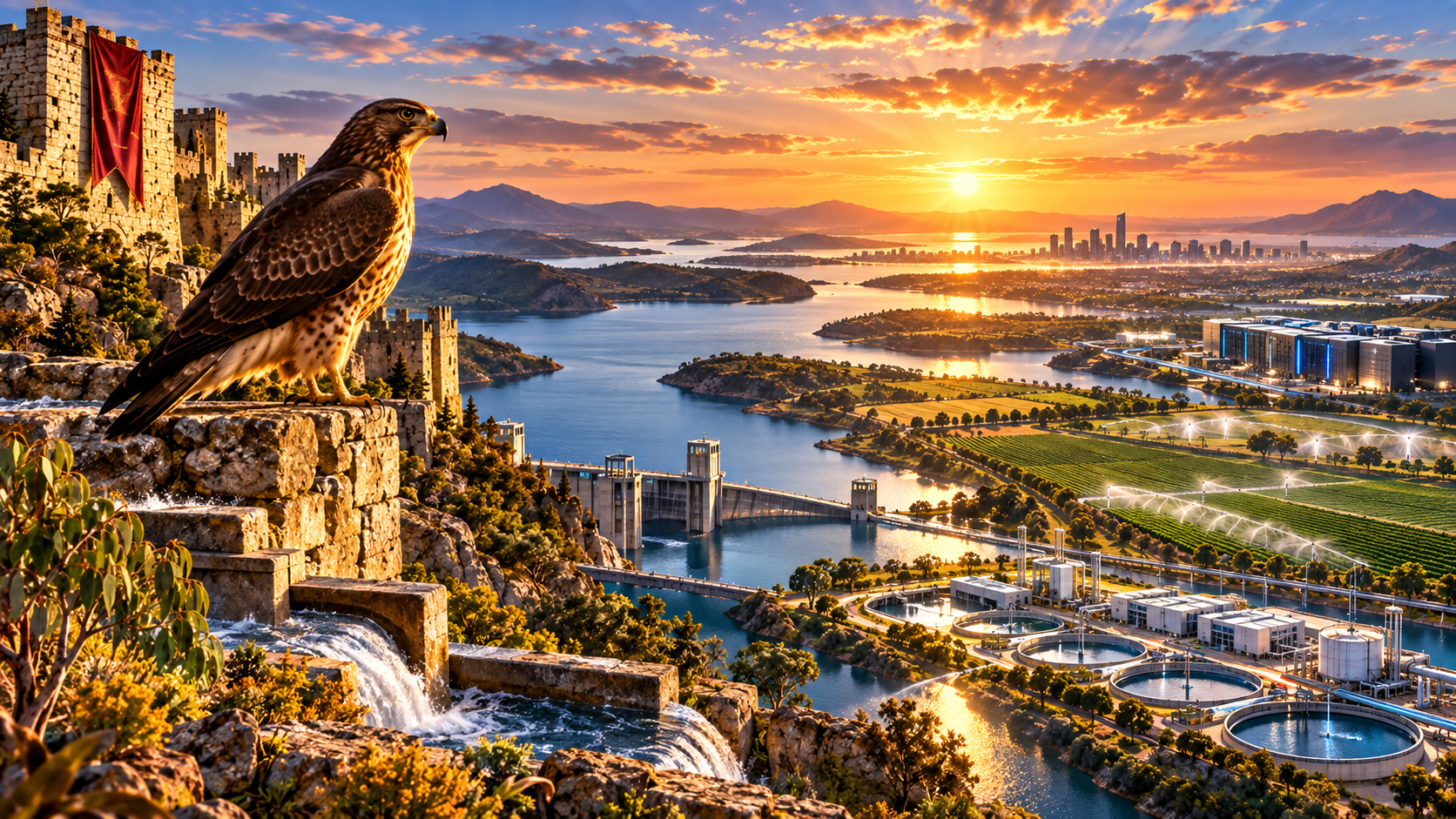
“Water Hawk” ©2026. pitchhawk. All rights reserved.
The signal
In January 2026, the United Nations declared a state of global water bankruptcy.
Not water stress. Not water scarcity. Water bankruptcy. 75% of the world's population now lives in countries classified as water-insecure or critically water-insecure. More than half of the planet's major lakes are drying up. Two billion people live on land that is subsiding due to groundwater over-pumping. And yet the entire WaterTech sector raised just $1.12 billion in venture capital in 2024, its record year. That is less than 2% of total global climate tech VC investment, deployed against a crisis underpinning roughly 60% of global GDP. Relative to the scale of the problem, it is a miniscule allocation. That structural mismatch between urgency and capital is the central signal in this edition.
But before we examine the investment landscape, here is the data point that stops every reader in their tracks. Because this signal does not begin in a lab or a boardroom. It begins in our own backyard.
Perth, Western Australia, is where I live. Beautiful beaches and hinterland. North of Margaret River, one of the world's great wine regions. South of the Midwest and Pilbara regions, the iron ore and LNG epicentres of the world. And west of a massive grain draw that produces wheat sought after right across Asia.
And here’s the problem. Rainfall in Perth has declined by only 15% to 20% since the mid-1970s. But that modest reduction has produced an 80% collapse in streamflow into the city's dams. Wait, what?
The reason for that 80% collapse is catchment physics. Dam catchments behave like massive sponges. After years of drying out, they absorb most rain before a single litre reaches the dam.
Before 2000, around the time the dot com bubble burst and I founded NextLevelCorporate, Perth needed 100mm of rain to generate 10 billion litres of streamflow. Today the Water Corporation's own General Manager of Assets Planning has stated publicly that it takes closer to 500mm for the same yield.
In 2025 Perth had its wettest winter in 30 years. Yet only 35 billion litres flowed into the dams against a pre-1975 average of 420 billion litres. The same General Manager has said publicly that Perth's dams may never spill again. By 2035, streamflow is expected to average just 40 billion litres per year. Rainfall now makes up only 10% to 15% of Perth's drinking water supply.
This article takes no position on the cause of that drying trend. Whether it reflects long-term climate cycles, anthropogenic climate change, or some combination of both is a question for scientists and policymakers. What is not in dispute is the physics, and the physics is staggering.
But this is not just a Perth-specific story. It’s a globally applicable demonstration of how a moderate reduction in rainfall, whatever its cause, interacts with catchment physics to produce a catastrophic collapse in usable water.
And the commercial response to it, a $2.8 billion desalination plant. This plant is the third of its kind in Perth, and it’s not an infrastructure upgrade. It’s the managed retreat of a major developed city from its own natural water supply.
Signal. Water technology is not an environmental investment theme. It is a strategic infrastructure thesis with sovereign demand, agricultural necessity, industrial dependency, and AI-driven urgency converging simultaneously. Yet it remains one of the most underfunded sectors relative to the scale of the problem in the entire investment landscape. That gap is correcting, with family offices and sovereign funds beginning to move alongside VC. And the businesses building commercial engines at the point of convergence will be among the most defensible in the technology landscape.
Why it matters, the scale of the problem and the industries it touches
According to the UN FAO, agriculture accounts for roughly 70% of global freshwater withdrawals, industry for approximately 20%, and municipal use for the remaining 10% (refer AQUASTAT database).
However, every one of those users is facing a structural supply constraint that no amount of policy or price signal can resolve without fundamental changes to how water is sourced, treated, distributed, and reused.
The scale of the commercial opportunity maps directly to the scale of the problem.
Market estimates from Market Research Future, Grand View Research, DataM Intelligence, SNS Insider, and Global Water Intelligence for the major WaterTech sub-sectors consistently project compound annual growth rates of somewhere between 8% to 12%, through to 2033 and 2035. This is across desalination, recycling and reuse, smart water grids, and precision irrigation, with the sector as a whole receiving less than 2% of total global climate tech investment despite underpinning 60% of global GDP.
That is the structural opportunity. And it is converging with a demand driver the sector never anticipated.
AI data centres can consume between 1 and 5 million litres of water per day for cooling. As AI compute capacity expands, water demand from the technology sector alone is becoming a material constraint on where data centres can be located. This has generated its own innovation response directly relevant to water scarcity.
Liquid immersion cooling, where servers are submerged in non-conductive dielectric fluid (think of cooking oil) rather than cooled by evaporated freshwater, consumes no water at all 👇
HPC centre, DUG, Perth, attended by Hawk1.
Microsoft's Project Natick, which deployed a sealed underwater data centre off the Orkney Islands cooled passively by seawater, achieved a power usage effectiveness of 1.07 against the land-based industry average of 1.3 to 1.6, while consuming zero freshwater. Microsoft discontinued Natick in 2024 citing operational complexity, but the lessons are being directly applied to land-based liquid cooling architectures. Space-based data centres, now in early development, are expected by some to offer the same passive cooling dynamic in vacuum.
The tension is worth naming directly. Every litre consumed by an AI data centre is a litre that cannot irrigate crops, sustain communities, or support mining operations. As AI compute scales toward the levels currently projected, the competition between intelligence and food for scarce water will shape investment decisions and regulatory frameworks in ways that most technology investors have not yet begun to model. Although there are many analogues to draw from, albeit at smaller scale. For example, food versus fuel with corn (tortilla versus ethanol) and rapeseed/canola/palm oil (cooking oil versus biodiesel).
The graveyard, what went wrong, why
Here at pitchhawk we don’t like to skip inconvenient truths and commercial blunders, because in many ways they can help today’s founders, investors and grant schemes and governments avoid the mistakes of the past.
Unlike the vertical farming implosion that we documented in Investor Signals #10, WaterTech's failures share a different, but equally instructive failure mode.
The industry calls it the "piloting valley of death." The technology works in the lab and in the pilot. It fails to become a commercial engine.
SOURCE Global is the headline case. It raised $270 million in total funding from investors including Breakthrough Energy Ventures, Microsoft's Climate Innovation Fund, and BlackRock. Its technology, solar-powered Hydropanels that extract drinking water from atmospheric moisture, was genuinely innovative and attracted some of the most sophisticated climate capital in the world. By 2025, the business was functionally dead.
The failure mode was specific. SOURCE marketed Hydropanels with a 20-year lifespan. It quietly reduced that commitment to 5 years of support. In the field, units were failing within two to three years, with reports of broken fans, dead batteries, and absent maintenance crews. A 2025 SEC filing sought $75 million in fresh capital but had sold only $19.3 million of it. Its investors, who had deep enough pockets to bridge it, chose not to. The LinkedIn page went silent in February 2025. Leadership departed. By mid-2026, the business was rated effectively defunct.
The lesson mirrors vertical farming precisely. Not the technology. The commercial engine. SOURCE built a product that could generate water from air. It did not build a commercial engine that could reliably maintain that product in the field at the cost structure the price point required. A 20-year lifespan that became a 2-year operational reality is not a technology failure. It is a commercial engine failure.
And like we said last week, what you end up with is an expensive demonstration of what is technically possible.
The piloting valley of death is the equivalent of vertical farming's energy cost problem. The technology crosses from pilot to contract in a small number of cases because the procurement cycles of water utilities are long, risk-averse, and conservative. Utilities want proven technology with operational references, not pilots. The businesses that understand this and build their commercial engines around it, generating the references, certifications, and track records that close the gap between pilot, process performance risk, and contract, are the ones that survive. The ones that seek to stretch a venture capital timeline across the entire project development and utility procurement cycle timeline by pitching it as technology, discover the mismatch too late.
The investor angle, five commercial engines worth understanding ⚙️
⚙️ Precision irrigation, the bridge between water and food
For readers who found pitchhawk through Signal #10 on AgTech and FoodTech, this is the connection point. Agriculture uses 70% of global freshwater withdrawals. Irrigated cropland represents only 22.5% of total cropland but produces approximately 48% of all crop value. The leverage is extraordinary, but most of it is still wasted.
According to Grand View Research, the precision irrigation market is valued at $8.74 billion in 2025, growing to $16.59 billion by 2033 at 8.6% compound annual growth rate.
Netafim, the global leader, partnered with Amazon India in February 2026 to deploy drip irrigation systems expected to save 325 million litres of water annually across 120 hectares alone.
Rivulis opened what it described as the world's largest manufacturing facility dedicated to drippers and sprinklers in November 2025.
Orbia Netafim launched its AI-powered Dosing 5G platform in February 2026, integrating self-learning AI to optimise water and nutrient delivery simultaneously.
Precision irrigation delivers the same analytical argument as precision agriculture in Signal #10. The technology reduces a farmer's most critical input cost on existing farms without requiring them to change what they grow or where they sell it. The commercial case is immediate and measurable. The data asset compounds over time. And the switching costs of a truly embedded precision irrigation system with proprietary soil moisture and yield data create the kind of defensible commercial position and signal that’s easily spotted by a professional investor in this space.
⚙️ Smart water infrastructure, the AI and digital twin thematic
Approximately 35% of all water that enters distribution networks globally is lost before reaching the end user. The commercial opportunity in recovering that water is worth hundreds of billions of dollars annually.
Xylem, which reported record 2025 revenues and completed its $7.5 billion Evoqua acquisition 18 months ahead of schedule, and Veolia, which secured a 20-year contract in Colombia to reduce network losses from 42% to below 30%, are demonstrating that AI-driven leak detection, digital twins, and smart metering generate measurable financial returns without requiring any policy change.
According to DataM Intelligence, the smart water grid market is projected to reach $59.57 billion by 2035.
⚙️ Western Australia and mining, the commercial necessity in our backyard
Mining is responsible for approximately half of Western Australia's total groundwater consumption, with roughly two trillion litres extracted annually from increasingly stressed aquifer systems. In the Pilbara, water availability is a direct operational constraint on production for one of the world's most important mining regions.
Rio Tinto committed $395 million to a seawater desalination plant at Parker Point in Dampier, now operational in 2026. BHP constructed a plant delivering over 2,500 litres per second powered by renewable energy. These are operational necessities. And for Perth itself, the $2.8 billion Alkimos Seawater Desalination Plant under construction will produce 100 billion litres of drinking water per year when operational in 2028, supplying 2.5 million Western Australians. It will be the third desalination plant of its kind in Perth, and it will be entirely renewably powered.
When a developed, resource-wealthy state builds its third major desalination plant because its natural rainfall can no longer be relied on as a primary water source, regardless of why that has happened, desalination has crossed from contingency infrastructure to primary water supply strategy.
It is what I noticed from the air when I first flew into Dubai in the early 2000s, it already accounts for the lion’s share of our potable drinking water here in Perth, and it is coming to every water-stressed region on earth.
⚙️ Aquifer discovery and water transport, the overlooked frontier
In May 2026, scientists confirmed the existence of one of the largest hidden aquifers on earth, stretching from New Jersey to Maine beneath the Atlantic Ocean floor. Expedition 501 drilled into the seabed off Massachusetts and found water with salinity levels as low as 1 part per thousand, equivalent to many land-based freshwater sources. Early estimates suggest the reservoir could hold enough water to supply New York City for hundreds of years.
Deep aquifers at depths of 400 to several thousand metres remain largely unexplored beneath parts of Africa, Arabia, Australia, and the Americas. The technologies required to locate, characterise, extract, and transport this water, ground-penetrating electromagnetic mapping, directional drilling adapted from oil and gas exploration, and long-distance pipeline infrastructure, represent a genuinely emerging commercial frontier. The oil and gas sector's core competencies in subsurface characterisation translate directly to deep aquifer work. Several major energy companies are already positioning themselves in this space.
And closer to home, Western Australia has its own chapter in the annals of ambitious water transport thinking. In 2005, then-opposition leader Colin Barnett proposed a $2 billion canal to pipe water from the Kimberley's northern rivers down to Perth, an idea that was immediately and affectionately dubbed "Col's Canal" by a grateful media. The political damage was considerable, contributing to his election defeat that year. Government task forces later estimated the real cost closer to $15 billion, and official state water planning blueprints eventually buried the concept entirely, concluding that local seawater desalination and groundwater recycling were the more commercially viable path forward. Col's Canal is a useful reminder that the water transport problem is real, the engineering challenge is formidable, and the gap between a compelling concept and a commercially fundable infrastructure project is precisely where political careers and investment theses go to die.
Aquifer water that cannot be moved economically to where it is needed provides no commercial value. Pipeline and distribution infrastructure connecting newly discovered water sources to water-stressed communities is an infrastructure investment thesis that shares the long-duration, contracted return characteristics of energy pipeline investment.
⚙️ Water recycling and reuse, the circular economy at scale
Veolia inaugurated France's largest treated wastewater reuse facility for agricultural irrigation in June 2026. California has committed $4.2 billion through 2030 for potable reuse infrastructure. According to Grand View Research, the water recycling and reuse market is growing from $17.57 billion in 2024 to $30.56 billion by 2030 at a 9.7% compound annual growth rate.
In agriculture, recycled water combined with precision irrigation generates measurable yield improvements and input cost reductions without requiring policy subsidy. These are commercially self-sustaining returns. They represent the strongest near-term commercial signal in the entire water technology stack.
The tipping point, four tests every water tech founder must pass
The piloting valley of death, the SOURCE Global collapse, and the structural underfunding of the sector all point to the same four-part test that every WaterTech commercial engine must pass. It mirrors the four-filter framework from Signal #10 on AgTech and FoodTech, because the failure modes are closely related.
Does it work beyond the pilot? Only a handful of water technology innovations cross from successful pilot to signed commercial contract. I have seen a figure of 25% used by Isle Utilities, although let’s just say well below half. In many cases, the technology works in controlled conditions. And the problem is similar to other sectors where the commercial engine must work in a messy, budget-constrained, risk-averse world. In this case, the world of utility and industrial procurement. SOURCE Global worked in the lab. But in Allensworth, California, where panels had been installed in 2021 to address arsenic-tainted groundwater, residents were pulling Hydropanels out of their yards by 2024 because they had stopped working, roughly two to three years into a system marketed with a 20-year lifespan. Oops.
Does it generate returns at current water prices? Intuitively, water remains dramatically underpriced relative to its scarcity value in most markets. A commercial model that only works when water is correctly priced is betting on a policy transition that may take a decade, and/or may change when a government changes. The strongest businesses generate returns at today's prices, without subsidies, and become dramatically more valuable as prices correct toward scarcity value.
Is your capital timeline matched to your customer's procurement cycle? Water utilities make purchasing decisions over years, not months. They require operational references, regulatory certification, and process performance clarity, guarantees and the kinds of requirements project financiers typically expect. Venture capital timelines simply cannot accommodate these temporal and commercial requirements. The businesses that raise the right type of capital, patient infrastructure capital, sovereign capital, or strategic corporate capital, against the procurement cycle they are actually facing are the ones that survive.
Does your data compound over time? The WaterTech businesses that are strong candidates to attract a premium valuation (or to simply attract aligned capital) are the ones generating proprietary data about water systems that improves in value as more of it is accumulated. Flow rates, quality parameters, soil moisture, consumption patterns, treatment performance and other valuable metrics across thousands of sites. That data has the potential to create switching costs that protect the commercial engine from replication in ways that technology alone cannot. Done in the right way, these businesses can raise their fortress walls inside a moat, making it difficult for an enemy to compete with the commercial engine.
Founder challenge
If you are building, enabling, or monetising water technology, whether that is desalination, recycling and reuse, precision irrigation, smart water infrastructure, water quality monitoring, aquifer exploration, water transport, or the AI and sensor systems that serve all of the above, the questions that pitchhawk asks, and that professional investors will ask, is not whether the world needs your technology.
💧 Have you crossed the piloting valley of death? A successful pilot is not a commercial engine. A signed contract, an operational reference, and a recurring revenue stream from a real customer paying real money are. The gap between the two is where most WaterTech businesses discover that their venture capital timeline and their customer's procurement timeline are structurally incompatible.
💧 Does your commercial engine work at current underpriced water levels? The businesses that generate returns today and become dramatically more valuable as water prices correct toward scarcity value, are the ones that will attract capital, as long as investors can hear/see that signal.
💧 Is the right type of capital matched to your technology's timeline? Platform bets, infrastructure plays, and precision agriculture tools require different investor relationships, different capital structures, and different preparation. Raising venture capital for a business with a 10-year path to utility contract scale is the water sector equivalent of raising venture capital for vertical farming. The mismatch compounds over time.
💧 Where does your data asset sit, and does it compound? The proprietary data generated by precision irrigation sensors, smart network monitoring, water quality measurement, and treatment performance tracking is the moat that protects the commercial engine. It improves with scale, creates switching costs, and generates the kind of signal that professional investors are seeking.
How pitchhawk helps you answer those questions
At pitchhawk, we don't start with your pitch.
📢
We start with your underlying business and investment thesis.
Using an outside-in, buy-side perspective, we diagnose whether you've been able to transform your innovation into a fortified and investable business. We pressure-test the underlying commercial engine to reveal the structural signals professional investors recognise. Then we help fortify what already exists, build what's missing, and show you how to wrap it in an investment thesis that helps professional investors recognise what you've actually built.
In water technology, that work reveals whether a founder has built a commercial engine or a compelling pilot. The piloting valley of death is real. SOURCE Global proved it with $270 million and some of the world's most sophisticated investors behind it. The businesses that cross it are the ones that understand the commercial engine requirements before the capital is spent, not after.
Our mission is simple. Helping innovation-led business builders transform their innovations into Fortress-Strong, Investor-Ready (and Buyer-Ready) businesses that professional investors can quickly recognise and confidently back.
💧 Are you listening to the signal?
pitchhawk is.
Mike 🖐

Innovation rarely stalls because of a lack of ideas.
It stalls in the gap between a great innovation and a fortress-strong investable business.
That gap never closed because nobody was incentivised to provide founders with an independent investor's lens.
pitchhawk is.
© pitchhawk, 2025-6. All rights reserved. You may not copy, reproduce or imitate our services, content, frameworks or intellectual property.