
Investor signals #3: Quantum Computing, all states until measured
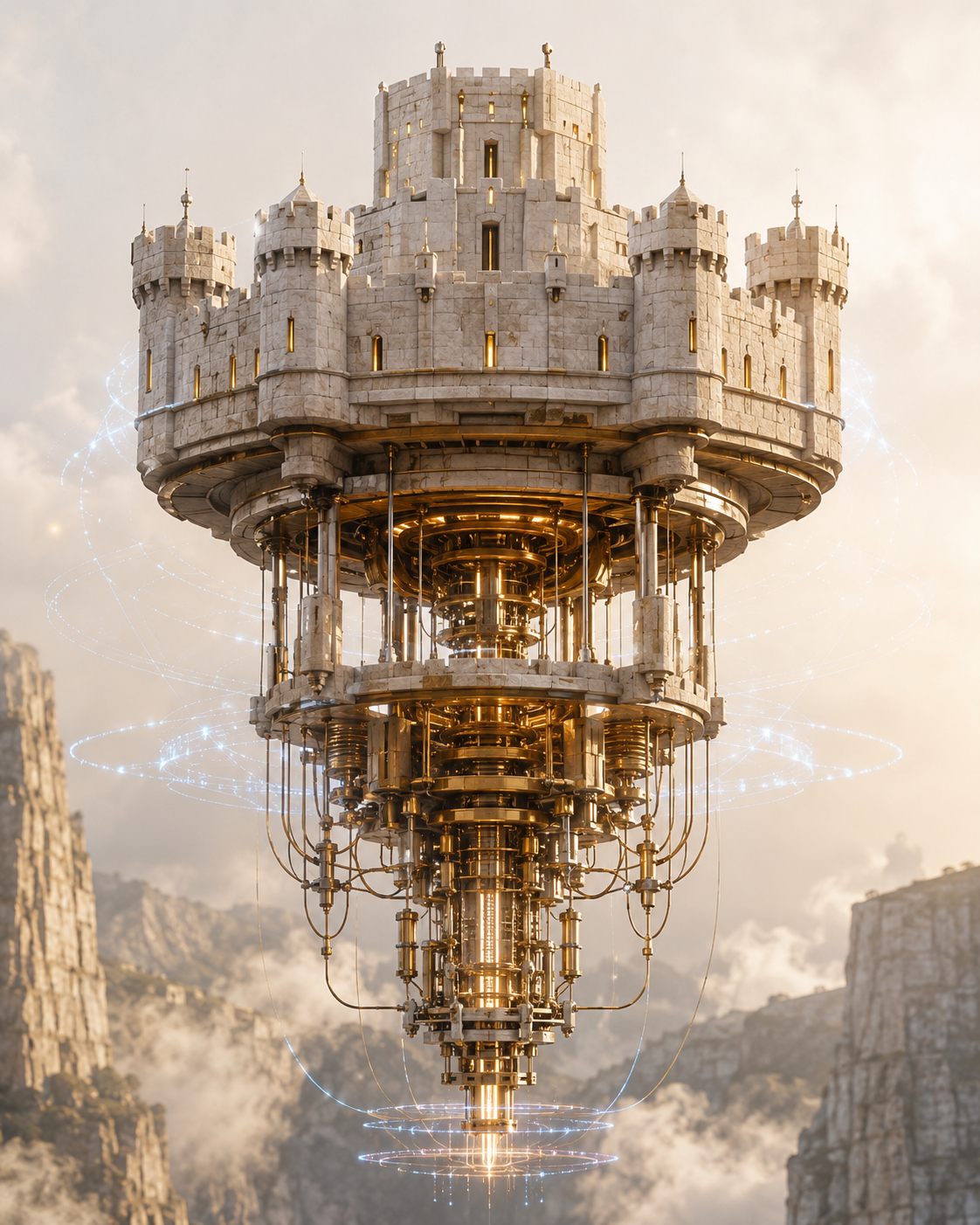
“Fortifying Quantum” ©2026. pitchhawk. All rights reserved.
The signal
Quantum computing is easy to dismiss and difficult to time because the technology operates in a realm most people will never directly encounter. You will never see a qubit, and you’ll probably never feel the difference between a classical computation and a quantum one. Yet the gap between what classical computers can solve and what quantum systems promise to solve is so vast it’s literally incomprehensible.
Classical computers process information in bits, ones and zeros. Quantum computers use qubits, which can exist in multiple states simultaneously through a property called superposition. Combined with entanglement, this allows quantum systems, which are based on the principles of quantum mechanics, to explore enormous solution spaces in parallel, solving in minutes problems that would take today's most powerful supercomputers millions of years.
That's not marketing hype. It's physics. Instead of forcing nature to behave like a classical computer, quantum computing harnesses the strange rules that govern reality itself. The same rules Stephen Hawking devoted his career to explaining.
Imagine a maze with 30 entrances. A classical computer sends one explorer through each entrance, one after another, until someone finds the exit. A quantum computer behaves as though it sends an explorer down every entrance at the same time. As the calculation unfolds, the wrong paths fade away while the correct path becomes stronger. The result isn't magic. It’s the strange physics of superposition and quantum interference at work.
Weird, right?
But here’s the investor's position that cuts through the funky narrative. Extraordinary technology is not the same thing as an investable business. And right now, quantum sits in a peculiar position, one of the most consequential technologies in human history, plenty of use cases, but still searching for its commercial engine.
Signal: Quantum computing is not a future technology. It’s a present investment thesis, with all the uncertainty and opportunity that implies.
Why it matters
Every wave of technological disruption eventually reaches the problems that brute computational force simply can’t solve. Quantum is the answer to that ceiling.
Drug discovery. Today's most powerful supercomputers can’t accurately simulate complex molecular interactions at the quantum level. A fault-tolerant quantum computer could model protein folding, drug-target interactions, and novel material compositions with a fidelity that would compress decades of lab work into months. The implications for oncology, rare disease treatment, and materials science alone are huge as explained to me at the recent Black Swan Summit that was held here in Perth back in March.
Cybersecurity. Quantum computers capable of running Shor's algorithm at scale will render most current encryption standards obsolete. Governments and enterprises are already investing heavily in post-quantum cryptography. Not as a precaution, but as a strategic imperative. This is a defence market being built before the weapon fully exists.
Financial modelling. Portfolio optimisation, derivatives pricing, and risk modelling involve combinatorial problems that classical computers approximate rather than solve. Quantum systems promise genuine solutions, not approximations.
Logistics and supply chain. Route optimisation across thousands of variables across use cases like global shipping, aviation scheduling, and energy grid management is a natural quantum domain. The commercial upside for the businesses that crack it first is enormous.
The pattern is consistent across every sector where quantum matters. The problems are real, the markets are large, and the commercial opportunities are all structural. What remains uncertain is the timeline, and that’s what makes this signal complex to read.
The investor angle
Professional investors increasingly see quantum not as science fiction, but as a long-duration capital thesis requiring careful positioning.
Billions are already flowing in. According to McKinsey, cumulative global investment in quantum computing exceeded $35 billion by 2023, with government and private capital accelerating in parallel.
The U.S., China, the EU, Australia, and the UK have all launched national quantum strategies. This is not venture capital speculation. It’s strategic infrastructure investment at a sovereign level.
But here’s what sophisticated investors know that most founders building in quantum don't fully appreciate. Like AI, the investment thesis differs sharply depending on where you sit in the stack.
Hardware companies building the actual quantum processors are long-duration, capital-intensive bets. IBM, Google, and IonQ are racing to demonstrate fault-tolerant quantum advantage at commercially meaningful qubit counts.
Close to home, PsiQuantum, backed by billions in Australian and US government funding, is building photonic quantum chips designed to scale to the million-qubit threshold required for practical computation. These are not businesses you back for a three-year return. They are infrastructure bets on a decade-long transition.
Software and algorithm companies occupy a different part of the risk curve. Firms like Quantinuum, Q-CTRL, and Zapata Computing are building the middleware, error correction tools, and domain-specific quantum algorithms that will sit between the hardware and the eventual commercial application. This layer is maturing faster than the hardware and is where near-term commercial traction is most plausible.
Application companies use quantum-inspired or hybrid classical-quantum approaches to solve specific industry problems today. They represent the most immediately investable segment. They are generating revenue, building customer relationships, and establishing the commercial beachheads that pure hardware plays cannot yet reach.
The question professional investors are asking here is no different to what they ask about AI, connectivity, or any other domain.
"As quantum becomes commercially viable, which businesses are structurally positioned to capture the value, and which are simply riding the tailwind until the wind changes direction?"
Examples in action
The quantum landscape is moving faster than most observers realise.
IBM's Quantum Network now counts over 200 organisations as members, including major banks, pharmaceutical companies, and aerospace manufacturers actively running hybrid quantum-classical workloads. It’s not R&D, it’s a commercial ecosystem being built ahead of the hardware's full maturity.
Google's quantum team published a landmark result demonstrating that their Willow chip performed a benchmark computation in under five minutes that would take today's fastest classical supercomputer an estimated ten septillion years. The milestone attracted significant investor attention because it confirmed the trajectory.
IonQ, the first publicly listed pure-play quantum computing company, is targeting the aerospace, pharmaceutical, and financial services sectors with near-term quantum advantage applications. Its trapped-ion architecture offers high gate fidelity at lower qubit counts, a deliberate commercial bet on near-term applicability over long-term scale.
PsiQuantum is perhaps the most ambitious capital deployment in the sector. It adopts a photonic approach to fault-tolerant quantum computing. It 2025 it raised a further US$750 million at a valuation of around US$6 billion with the Commonwealth and QLD governments tipping in A$940 million to build a utility-scale quantum computer in Brisbane. The bet is not on near-term commercial return. It’s on owning the foundational hardware layer when the market reaches critical mass.
Quantinuum is a joint venture between Honeywell and Cambridge Quantum. It’s busy building the full quantum stack, i.e., hardware, software, and applications in a vertically integrated model that mirrors the approach of the most defensible technology businesses.
The actors are serious. The capital is real and flowing. The race is on and while not as loud as the AI build out, you can see the arm’s race developing.
The tipping point
For years, quantum was a research domain, funded by government, academically driven, and commercially distant.
Today, it’s a strategic platform. Early commercial pilots are live across healthcare, finance, logistics, and defence. Hybrid quantum-classical approaches are already generating measurable value in optimisation and simulation problems where classical computers struggle. And as error correction improves and qubit counts increase, the gap between what is possible in the lab and what is deployable in a commercial environment is closing faster than consensus expects.
But building a business in this ecosystem requires navigating a challenge that is unique to quantum, which is that the commercial window and the technology window are not yet fully aligned. Founders must compete for investment capital while markets are still taking shape, revenue timelines are uncertain, and the dominant architecture has not yet been determined, i.e., superconducting, photonic, trapped-ion or topological?
That last part means that success is no longer determined solely by building great technology, rather, it’s determined by building an investable business capable of attracting the capital needed to reach the market before the architecture race resolves, and to survive if it resolves differently than you expected.
Quantum's tipping point is not a single moment. It’s more of a rolling threshold that different sectors will cross at different times. The founders who understand that, and build accordingly, are the ones professional investors will more likely back.
Founder challenge
If you’re building in quantum, enabling quantum, monetising quantum, or defending against its eventual disruption of your existing business model, capital will almost certainly become your greatest strategic constraint long before technology does. Deeptech takes time and an almost endless stream of capital.
And that’s where investors come in. For the professional investor, the question is never simply whether your quantum innovation works. It’s whether you’ve actually built something they can recognise as an investable business. And to find an investable business they look for patterns that they are familiar with. And to find those patterns, they ask questions, like:
⚛️ Are you building quantum infrastructure, enabling the quantum ecosystem, or applying quantum to a specific commercial problem where you have a defensible edge?
⚛️ Does your business generate value before full fault-tolerant quantum advantage arrives, or does your entire model depend on a hardware threshold that has no confirmed timeline?
⚛️ Have you built a revenue model that can be stress-tested, one that holds under scrutiny even if the technology timeline extends by three, five, or ten years?
⚛️ Do you have a moat? Or are you building a capability that IBM, Google, or a well-funded national programme will commoditise the moment they reach your qubit count?
Those are some of the signals professional investors are tuning their headsets to.
How pitchhawk helps you answer those questions
At pitchhawk, we use an outside-in, buy-side lens to diagnose whether a genuine investable business exists under, behind, and around your innovation. Then we fortify what exists, build what's missing, and show you how to wrap it inside an investment thesis that professional investors can recognise.
In quantum, that work is particularly important. The technology is extraordinary. The market is real. But the gap between a compelling quantum innovation and a fundable quantum business (or a business in the making) is wide, and the founders who close it before they walk into the capital markets are the ones who will attract the right capital at the right terms.
Our mission is simple. Helping founders transform innovation into fortress-strong, investor-ready businesses that professional investors and buyers can recognise, and confidently support.
⚛️ Are you listening to the signal?
pitchhawk is.
Mike 🖐

Innovation rarely stalls because of a lack of ideas.
It stalls in the gap between a great innovation and an investable business.
That gap never closed because nobody was incentivised to provide founders with an independent investor's lens.
pitchhawk is.
© pitchhawk, 2025-6. All rights reserved. You may not copy, reproduce or imitate our services, content, frameworks or intellectual property.